
Sovereign AI Operations
Own the capability. Don’t rent the intelligence.
Data, runtime, credentials, approval, & the audit trail your institution controls.
The serious AI decision is not which tool to buy. It is whether your institution will operate intelligence inside boundaries it controls, or become a tenant inside someone else’s platform, contract, jurisdiction, and runtime.
For regulated African institutions, sovereignty has to show up in the architecture: data residency, inference control, credential boundaries, approval gates, audit trails, and the ability to operate under consequence.
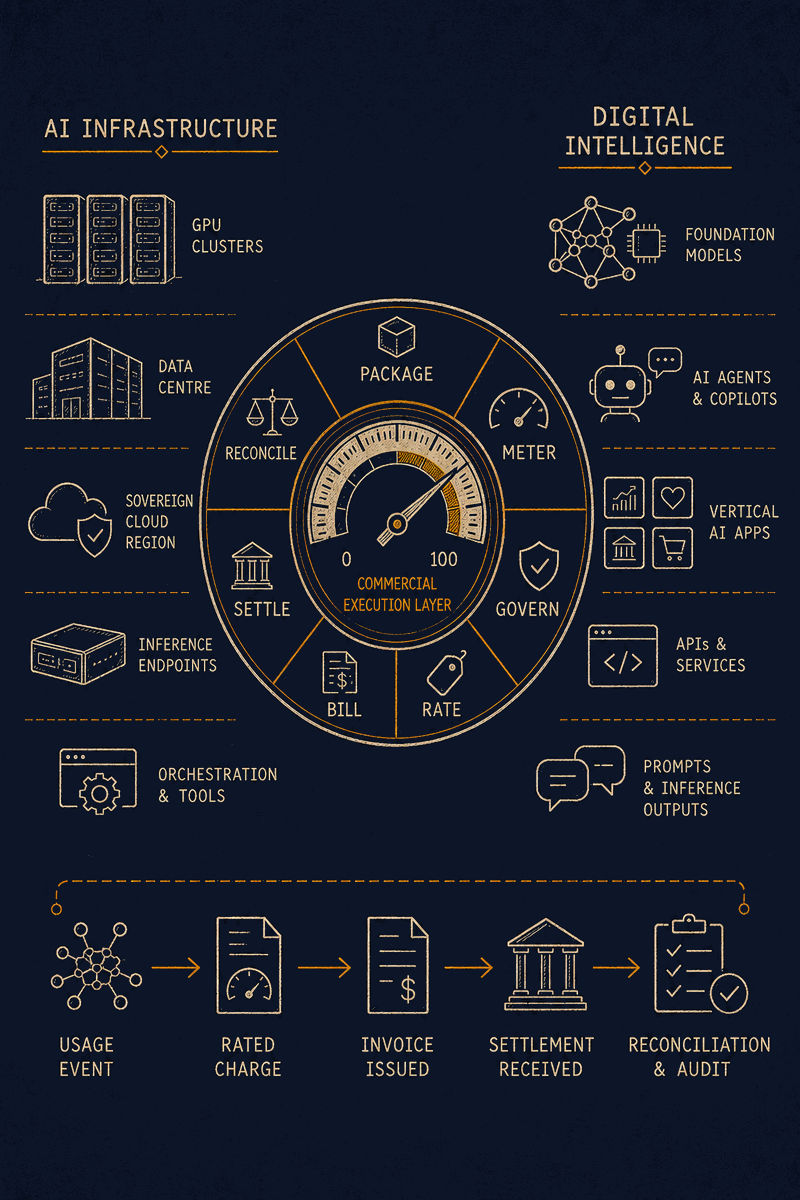
The tenancy trap
The easy AI buy becomes the expensive dependency.
Most AI programmes start with something small. A productivity layer for staff. A chatbot framework. A dashboard with a model behind it.
The vendor says the risk is contained. The integration looks simple. The subscription can start quickly. That may be fine for low-risk work. It is not enough for institutions that handle citizen data, customer identity, network operations, financial decisions, health records, industrial operations, or regulated workflows.
The first use case is rarely the problem. Tenancy is. The data, prompts, outputs, workflows, model path, and runtime logic begin to live inside someone else’s platform. The institution operates AI, but it does not own the capability.
Buyer questions
- Where does sensitive data go?
- Where does inference actually run?
- Who controls the model path and runtime?
- Who can compel access?
- Who owns the prompts, workflows, outputs, and operational logic?
- Can the institution defend the decision to a regulator, board, risk committee, or citizen?
The API fallacy
Local hosting is not sovereignty if inference leaves the perimeter.
A local database does not make an AI system sovereign if every meaningful prompt is routed through a public model API. A local cloud region does not solve the problem if credentials, inference, workflow execution, approvals, and audit trails sit outside the institution’s control.
Sovereign AI needs the full operating path to be designed deliberately: data, model access, inference, credentials, tools, workflow, approval, execution, evidence, and support.
Public APIs can still have a place. Low-risk work may justify them. The mistake is calling an architecture sovereign when the consequential part of the work leaves the boundary.
Sovereignty in name
Local hosting, public inference, external credentials, weak approval, partial audit.
Sovereignty in operation
Controlled infrastructure, controlled inference, local credentials, human gates, audit trail, recoverable operations.
Regulatory direction
AI governance is moving from policy to evidence.
AI policy and regulation are moving toward the same hard questions: who is accountable, what risk category applies, where data moves, how decisions are explained, who approves action, and what evidence exists after the fact.
Across regulated markets, the direction is clear even where local rules are still forming. High-impact AI needs governance the institution can show. TAUSPACE treats that as an architecture problem first. Legal wording can describe the control. It cannot create it.
Regulatory and policy direction is moving toward stronger evidence, control, accountability, and risk governance for AI systems. This page is not legal advice and does not claim compliance with any specific law or standard.
Six commitments
Sovereignty has to be engineered.
For TAUSPACE, sovereign AI is a set of structural commitments. Each one has a place in the operating path. None of them can be added later by a vendor promise.
[SOV.01]
Infrastructure control
Deploy in a controlled data-centre, private cloud, on-premise, or sovereign-region environment where the institution understands the perimeter.
[SOV.02]
Site-local execution
Sensitive credentials and site-specific integrations stay inside the local execution boundary. The centre knows what must happen. The local daemon knows how to do it safely.
[SOV.03]
Deterministic-first reasoning
Hard operating data leads. AI commentary supports the decision; it does not replace the record.
[SOV.04]
Gated mutation boundaries
AI can propose a state change. The system pauses before consequential action. Human authority stays explicit.
[SOV.05]
Audit and provenance
Decision paths, approvals, runtime events, and domain events are captured so the work can be reviewed after the fact.
[SOV.06]
Carrier-grade operation
AI inside consequential operations needs SLAs, recovery objectives, incident response, and production discipline.
fullCIRCLE NEXT and governed intelligence
A model can reason. It should not be allowed to act alone.
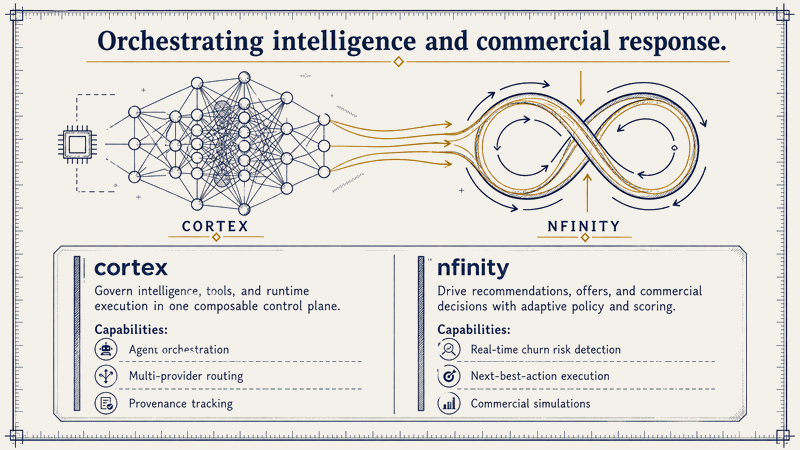
A model can reason. It should not be able to decide, approve, and execute a consequential change on its own. fullCIRCLE NEXT treats governed intelligence as an operating fabric. Each part has a job. The safety comes from the boundary between them.
cortex
Reasons, routes model providers, manages intelligence runtime, and supports agent workflows.
netra
Holds approval authority, operator surfaces, governance gates, source-of-record, and audit trail.
nova
Executes locally where networks, devices, field systems, and credentials need to stay protected.
axon
Connects systems, domains, events, and contract seams without turning the platform into integration chaos.
nfinity
Carries commercial policy, scoring, recommendation logic, eligibility, and decisioning semantics.
orbis
Coordinates customer, order, service, and business interactions.
nomia
Carries monetisation: charging, balance, billing, recovery, settlement, and revenue events.
Where this becomes real
The use cases change. The consequence does not.
Telecommunications
Network operations intelligence, revenue assurance, churn intervention, 5G charging, customer value management, and field execution.
Financial services
Fraud detection, risk scoring, AML support, regulatory reporting, customer treatment, settlement, and evidence.
Government and public sector
Citizen-facing services, sensitive data workflows, policy operations, and service delivery under national jurisdiction.
Healthcare
Patient-data environments where inference, access, audit, and review have to be controlled.
Industrial and mining
Asset performance, predictive maintenance, environmental support, supply-chain intelligence, and site-local execution.
Engagement model
No serious institution should sign this on the first call.
The work should move in steps, and each step should produce evidence. Each step earns the next.
Step 1
First conversation
A candid principal-level conversation about where AI will and will not produce impact.
Step 2
Strategic diagnostic
A board-grade analysis of AI posture, value pools, sovereignty exposure, architecture options, and the phased roadmap.
Step 3
Anchor capability deployment
One AI capability deployed through the full operating path against a real operational problem in a controlled environment.
Step 4
Embedded engagement
Multi-year capability build, platform operation, governance cadence, and progressive transfer of capability to internal teams.
Rent the tool, or own the capability.
Sovereign AI is harder than a subscription. That is the point. The capability should outlast the vendor relationship, the infrastructure migration, and the first use case.
Where this connects
Related work across the platform & advisory.
fullCIRCLE NEXT
The operating fabric that carries intelligence, decisioning, execution, and monetisation through one governed system.
See the platformRisk and revenue assurance
Audit, approval, leakage detection, and control evidence for AI services and live commercial operations.
See the practiceBSS/OSS architecture and migration
Move toward AI-ready architecture without breaking the live business or losing the audit trail.
See the practice