
Launch a brand or service fast·orbis·Digital BSS
The brand is ready. The platform shouldn’t make it wait.
Digital BSS you configure in weeks, not a stack you integrate for a year.
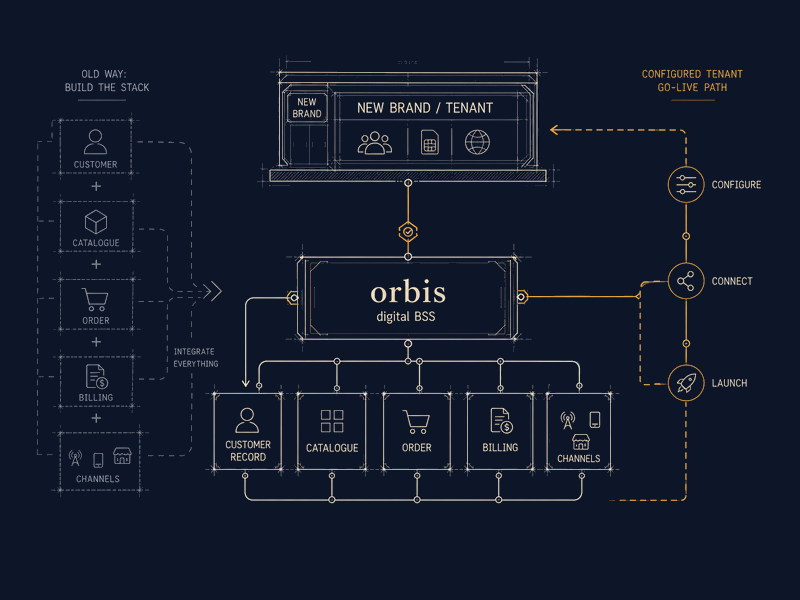
Standing up a new brand, MVNO, or service used to mean building or renting a full telco stack first: a CRM, a catalogue, an order manager, billing, and a channel, then spending most of the budget testing the seams between them. Digital BSS on fullCIRCLE NEXT collapses that into one platform you configure. The customer record, the catalogue, and the billing are already wired together, so you shape a tenant and go to market. You do not build a BSS.
Why launches stall
Launches get blocked by the platform, not the brand.
The traditional path runs twelve to eighteen months and a large capital line. Most of the budget goes into integration, not product.
And once it’s live, the brand stays hostage to it. Every commercial decision, a new bundle, a promotional price, a partner tier, crosses an engineering boundary before it reaches the market. The team that owns the P&L waits on the team that owns the platform. The brand that wins is the one that reaches the market while the opportunity is still open, and when every change is an integration ticket, the opportunity usually closes first.
The engagement core
One customer record. Every brand, every channel.
Digital BSS starts with the customer. The engagement core, orbis, holds one record for every subscriber across every brand and every channel: who they are, what they have, what they owe, what’s next for them. Order capture, catalogue, configure-price-quote, self-service, and partner operations all read and write that one record.
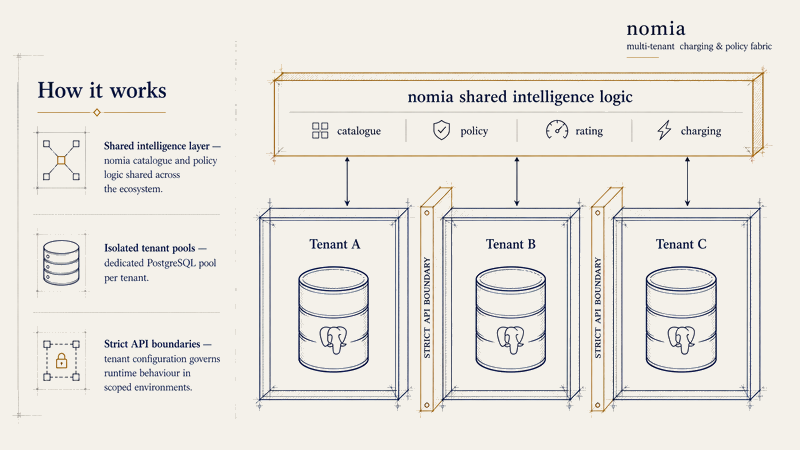
Where the customer meets money, billing and charging hand to nomia: real-time rating, billing, and balances across prepaid, postpaid, and hybrid on one engine. One customer, one catalogue, one bill, whether they bought on the app, in a store, or through a partner.
Unified customer
One subscriber record across every brand, channel, and product. Care, self-service, and the app all see the same customer and the same balance.
Configurable catalogue and CPQ
Define products, bundles, and pricing once. The same catalogue drives ordering, rating, and billing, so a price change is one change, not five.
Channels and partner ops
App, web, USSD, and partner channels on one platform, with partners running as governed tenants under your brand.
Why the second brand is cheaper
The second brand costs less than the first.
Because the platform is multi-tenant, a new brand, MVNO, or sub-brand is a tenant on shared infrastructure, isolated at the database layer by netra, not a fresh build. You configure the catalogue, the pricing, and the channel, and go live in weeks. The platform is already there; you are shaping it, not constructing it.
The first brand pays to stand the platform up. The second runs on the same infrastructure with its own catalogue, branding, and pricing, isolated from the first but sharing the engine beneath. Each additional brand costs less and launches faster than the one before.
For the isolation and rollout model behind tenancy, see Deployment.
From idea to in-market
Configuration replaces release.
Launching a product is a configuration workflow, not an engineering release. The same sequence runs whether it is a new tariff, a bundle, or a whole brand.
Design
Model the product, the price, and the rules in the catalogue. No code, no deployment.
Validate
Test it against real scenarios in a sandbox tenant before it touches a live customer.
Govern
The change passes a netra approval gate. Who approved what, and when, stays on the record.
Publish
The approved product goes live across every channel at once, app, web, store, and partner, from the one catalogue.
Sell
Orders flow from any channel through orbis to provisioning and billing, with no manual hand-off between systems.
Iterate
Watch how it performs, adjust the price or the rule, and run the same loop again. A change is minutes, not a release cycle.
Speed, governed
Speed without governance is just speed toward the wrong outcome.
Configuring a product in minutes is only an advantage if the wrong product can’t reach customers by accident. Every change on the platform is governed. cortex can propose a price or an offer, netra holds the approval gate and the audit record, and nova carries the approved change to execution. Automation proposes the change; governance decides what ships; execution follows.
So the commercial team moves at configuration speed without the platform team fearing what they’ll ship. The record shows who changed what, who approved it, and when it went live — every time.
For how the governance gate works across the platform, see the Modules page.
What it carries
What you can run on it.
Launch a brand
Stand up a consumer or enterprise brand as a tenant, with its own catalogue, pricing, and channels.
Run an MVNE programme
Carry multiple MVNO partners on one multi-tenant backbone, each onboarded and billed in a standard pattern.
Operator SuiteEmbed connectivity
Add a SIM or eSIM line to a banking, retail, or device proposition, governed under the parent business.
Bank MVNO journeyTest a pricing model
Stand up a sub-brand to trial a new tariff or segment without risking the main book.
Onboard a channel
Bring dealers, resellers, and partners onto a governed environment with scoped catalogues and managed commission.
Channel SuiteAdapt a partner scheme overnight
Change a commission scheme or a partner tier by configuration, in force the next day, not the next release.
The architecture underneath
How it composes.
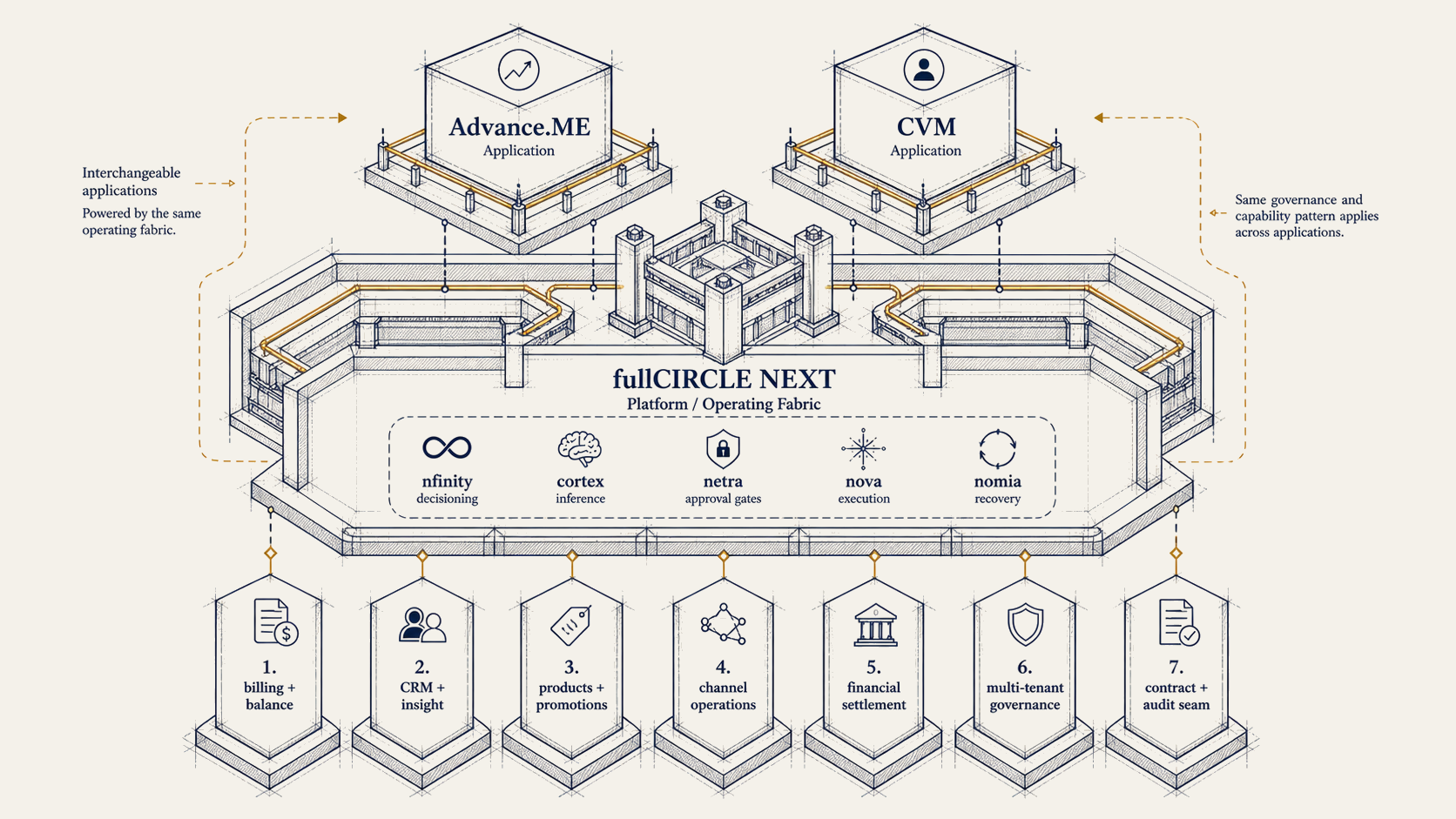
Digital BSS isn’t one product. It’s the platform’s modules working as one, each doing one job, in your language:
- orbis runs engagement: the customer record, the catalogue, and every order or care touch on top.
- nomia is the money engine: real-time rating, billing, and balances across prepaid, postpaid, and hybrid.
- cortex provides the intelligence: scoring offers and automating the busywork around them.
- netra holds the governance: every approval gate, every audit entry behind it.
- axon connects the fabric: the modules to each other, and the platform to the systems you still operate.
- nova handles execution at the edge, where latency or data residency demand it.
Where Digital BSS connects
The launch is the start, not the whole platform.
Pair it with Advance.ME
The launch-fast pairing: turn the moment a prepaid subscriber hits zero into a governed service advance, recovered at the next top-up.
See Advance.MEReal-time billing and charging
Where the brand meets money, nomia rates, bills, and charges in real time across prepaid, postpaid, and hybrid.
How charging worksRoll it out in stages
Stand the platform up beside the systems you still run, and migrate domain by domain once each is proven.
See DeploymentTell us what you’re trying to launch.
Tell us the brand you want to launch, who you’re launching it for, and where it has to reach. We’ll show you how fullCIRCLE NEXT stands it up as a tenant, and what configuration, not construction, looks like for your case.