
Platform · Operating fabric · Governed intelligence
fullCIRCLE NEXT
Meters revenue, decides offers, governs change, executes at the edge. One platform.
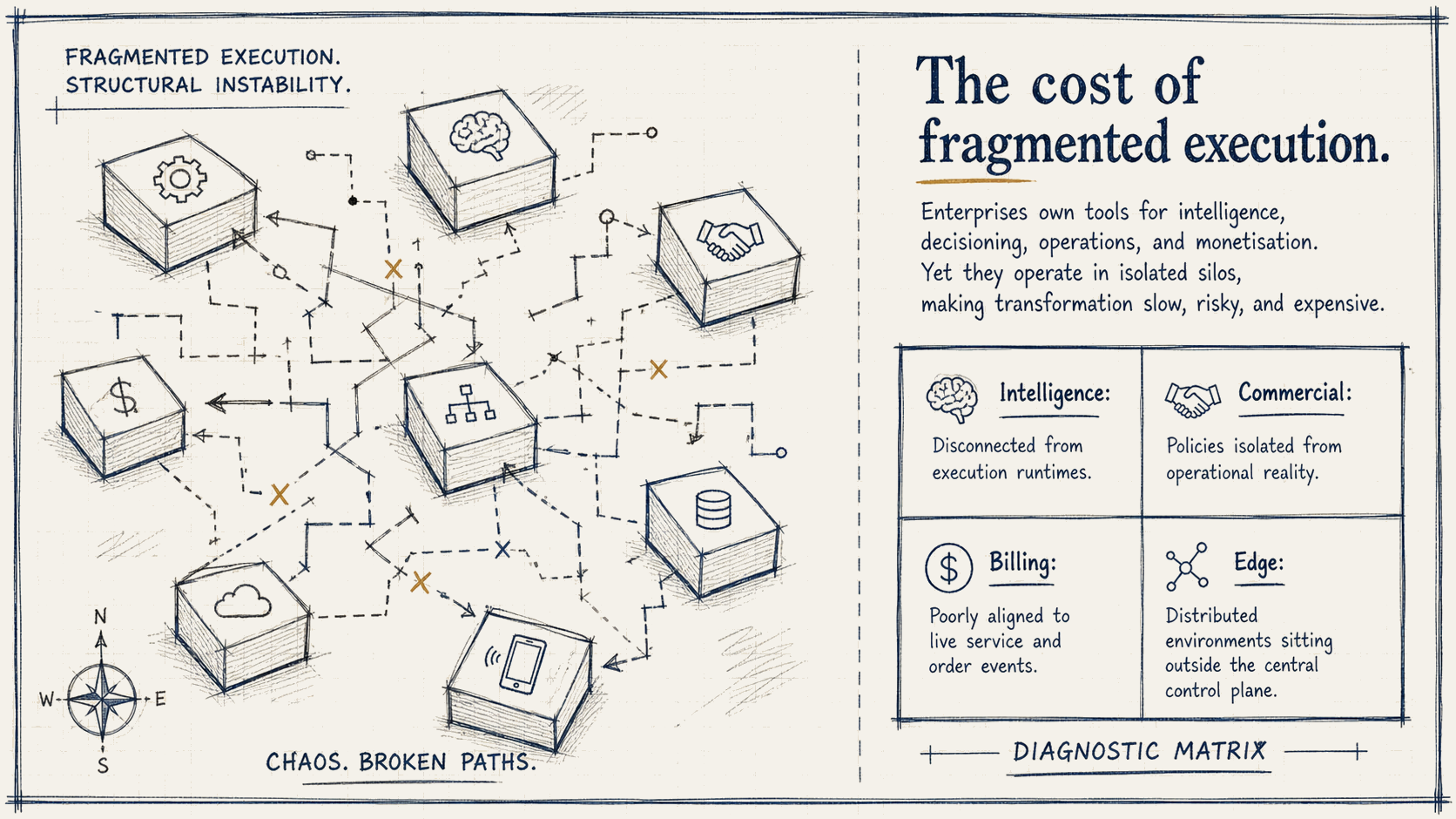
Telecom commercial and operational systems are fragmenting faster than they integrate. Charging in one place, decisioning in another, AI bolted on as dashboards, the network edge locked outside the control plane.
fullCIRCLE NEXT was built the other way around. One operating fabric carrying intelligence, decisioning, monetisation, and execution across the enterprise and the edge. Seven modules. One governed system.

The fragmentation problem
Six systems wearing a logo is not a platform.
Most BSS estates grew up one product line at a time. Postpaid got a billing system. Prepaid got a separate one. Mobile and fibre got their own catalogues. Partner settlement happens in spreadsheets. Real-time charging exists only where the network forced it. AI gets bolted on as reporting dashboards.
That’s not a platform. That’s six systems wearing a logo. The operating cost compounds with every new service. The launch velocity collapses. The team spends more time integrating than building.
“Intelligence belongs in the system, not bolted on as dashboards after the fact.”
Systems architecture comparison
What changes when intelligence joins the architecture.
Five dimensions where legacy stacks break and fullCIRCLE NEXT holds. Each row is one architectural decision, applied consistently across the platform.
Legacy stack
fullCIRCLE NEXT
Runtime Intelligence
Fragmented AI pilots, isolated from operations
Governed AI orchestration, in line with operations
Commercial Decisioning
Static, isolated logic
Adaptive policy aware of revenue and intent
State Governance
Weak source of record, reconciled later
One trusted operational core, on the record
Monetisation Latency
Batch-processed, lagging
Real-time billing and charging
Edge Capability
Outside the control plane
Governed local execution at the site
This isn’t a feature comparison. It’s an architectural one. Each row shows how the system holds together, not what you can do with it.
Seven modules, one fabric
Each module owns a clean boundary.
fullCIRCLE NEXT is built as seven modules, each with a distinct role. cortex governs intelligence. nfinity drives commercial decisions. nomia controls monetisation. orbis manages customer and order lifecycles. netra holds the governed source of record. axon connects the fabric between them. nova executes at the edge.
Cross-module communication flows through axon's signed contracts. No module imports another directly. The result is a platform that scales by composition: adding a module doesn't reshape the rest.
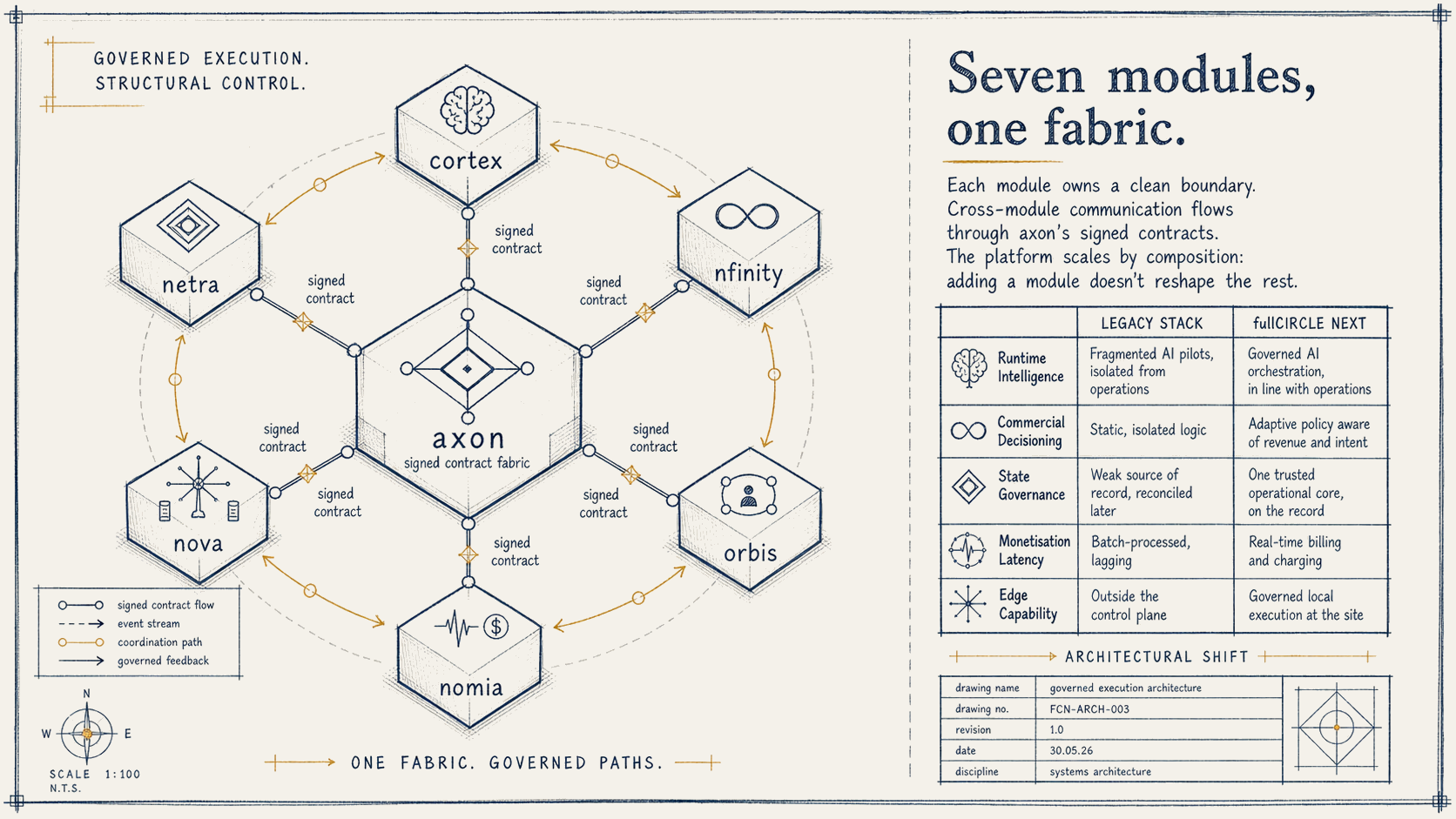
A unified architecture, replacing a fragmented billing and operations stack.
cortex
the agent runtime: where AI does work, under governance
nfinity
the decisioning engine: every commercial choice scored against intent
netra
the system of record: every state change auditable, every approval gated
orbis
the engagement core: one record for customer, catalogue, and order, across every brand and channel
nomia
the money engine: real-time rating, billing, and balance across prepaid, postpaid, and hybrid
axon
the connecting fabric: signed contracts between modules, and to the systems you still run
nova
the edge runtime: where latency, sovereignty, or an air-gap put execution at the site, not in the cloud
Each module is an independent application. axon's signed contracts hold the system together.
Explore each module in detailApplications on the fabric
nfinity hosts the apps. cortex powers them. Operators run them.
fullCIRCLE NEXT is the operating fabric. The applications you actually launch with, Customer Value Management and Advance.ME, run as governed apps on nfinity, with cortex underneath providing AI inference.
Same fabric. Same governance. Different commercial surfaces.
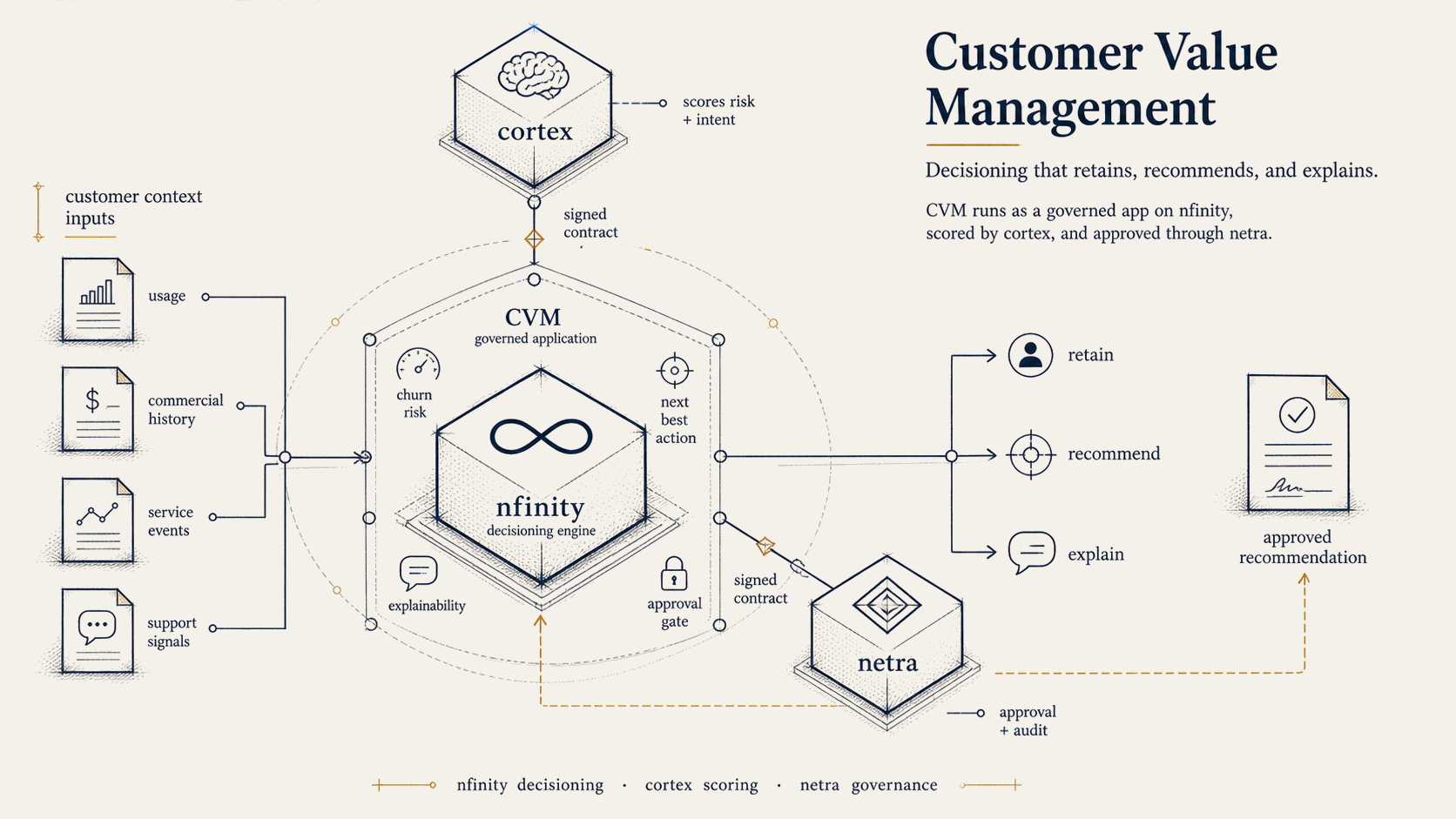
Customer Value Management
Decisioning that retains, recommends, and explains.
CVM as a governed app on the nfinity decisioning engine, scored by cortex. Proactive churn-risk detection, AI-recommended next-best-actions, transparent decision explainability, under approval gates with full audit.
Underlying modules: built on nfinity, scored by cortex, governed by netra
Explore CVM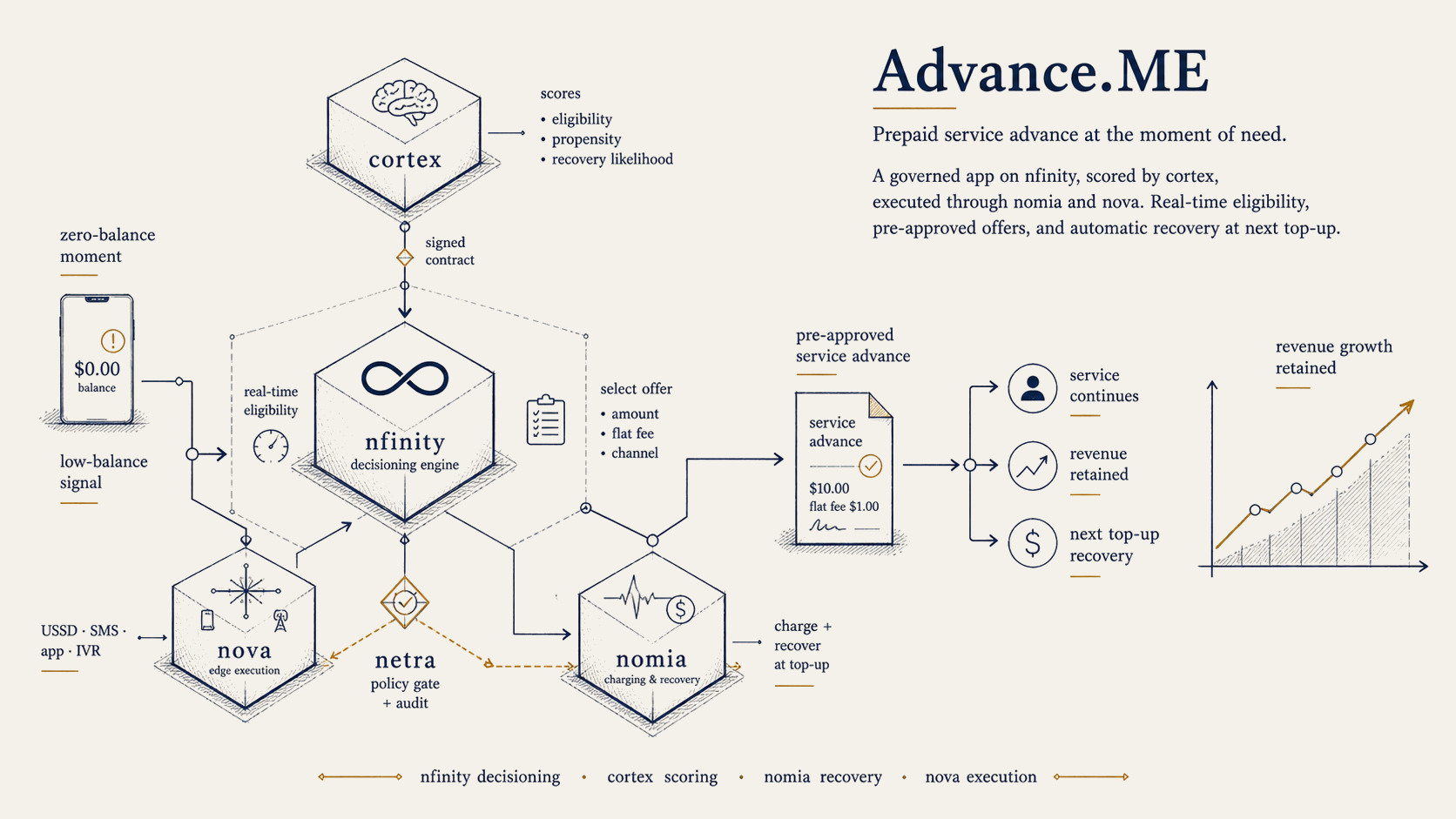
Advance.ME
Prepaid service advance at the moment of need.
A prepaid service advance app running on nfinity, scored by cortex. Real-time eligibility, governed offers via USSD/SMS/app, automatic recovery at next top-up. Pre-approved in seconds.
Underlying modules: built on nfinity, scored by cortex, executed via nomia and nova
Explore Advance.MEGovernance by design
Strict operational boundaries. Multi-tenant by architecture.
fullCIRCLE NEXT was designed for telecom operators running multiple business units, wholesale partners, and retail divisions on shared infrastructure. The boundaries between them are enforced at the architecture level, not at the application level.
[SYSTEM.BOUNDARY.01]
Applications are independent.
No module imports another directly. netra owns the operator UX. orbis owns customer and order state. cortex executes intelligence. No mixed responsibilities, no shared domain logic, no big balls of mud.
[SYSTEM.BOUNDARY.02]
Built for concurrency and fault tolerance.
Elixir/OTP, Phoenix 1.7+, Ash Framework, per-app PostgreSQL 15+ databases. The platform handles concurrent subscriber events and fails partially without taking the system down.
[SYSTEM.BOUNDARY.03]
Wholesale and retail on one infrastructure.
Designed for operators with retail, wholesale, MVNE, and partner divisions running on shared infrastructure without data leakage. Tenancy is enforced at the database layer, not bolted on as an application policy.
The same applies to decisions cortex suggests. The agent proposes a tariff change, a customer treatment, or a partner billing correction. Your operations team approves it. The system of record executes it. cortex runs on the same infrastructure the rest of the platform uses, inside the operator’s data perimeter.
Modular deployment architecture
Three ways to deploy. One architecture.
fullCIRCLE NEXT supports the operating model your business needs today and the migration path to the one you need next. Replace the stack in one programme, or migrate domain by domain, or distribute execution to where the network actually lives.
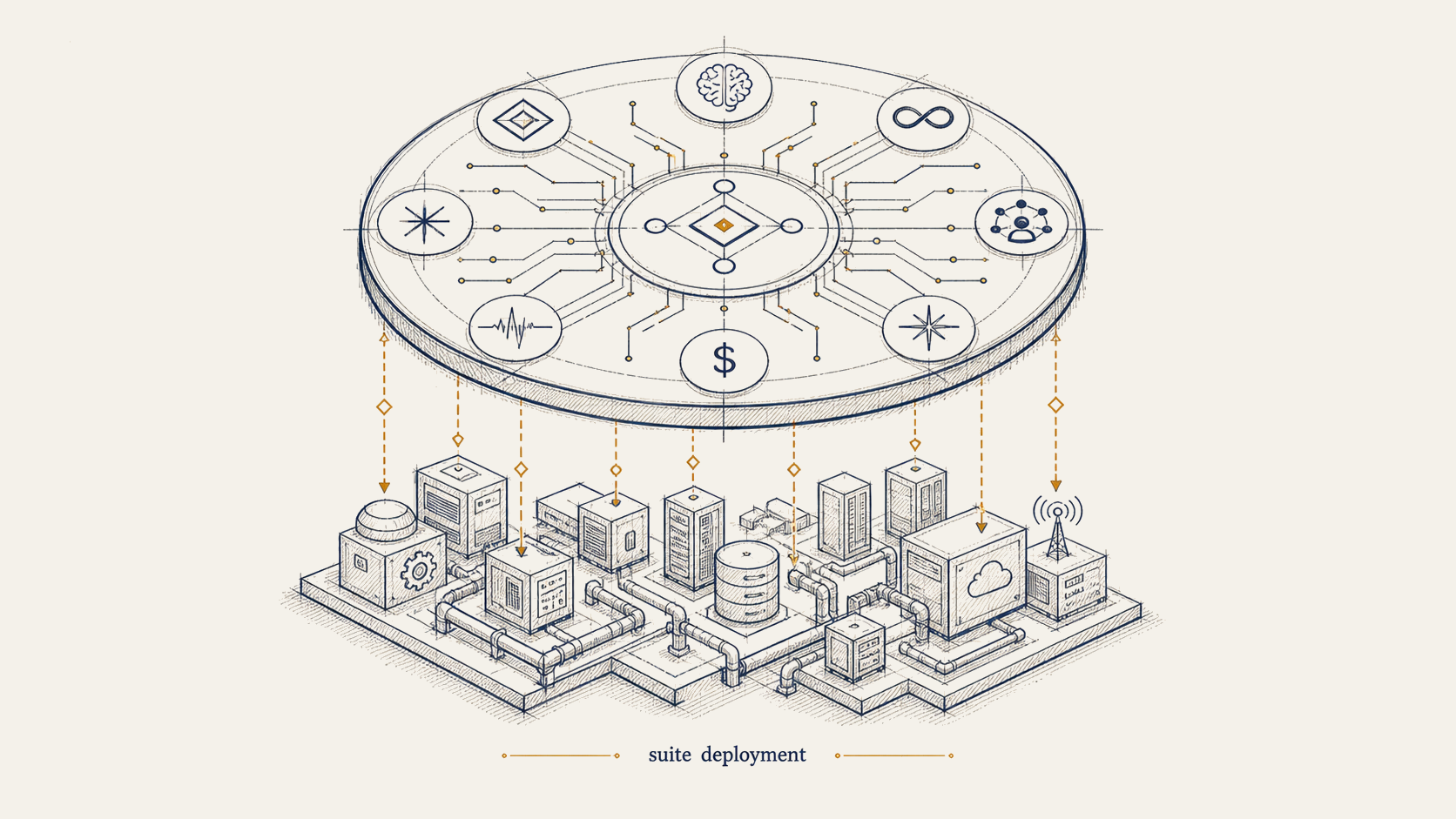
Full platform rollout
Complete operating model transformation. Best for greenfield operators, new MVNOs, bank MVNO launches, and operators with end-of-life BSS estates.
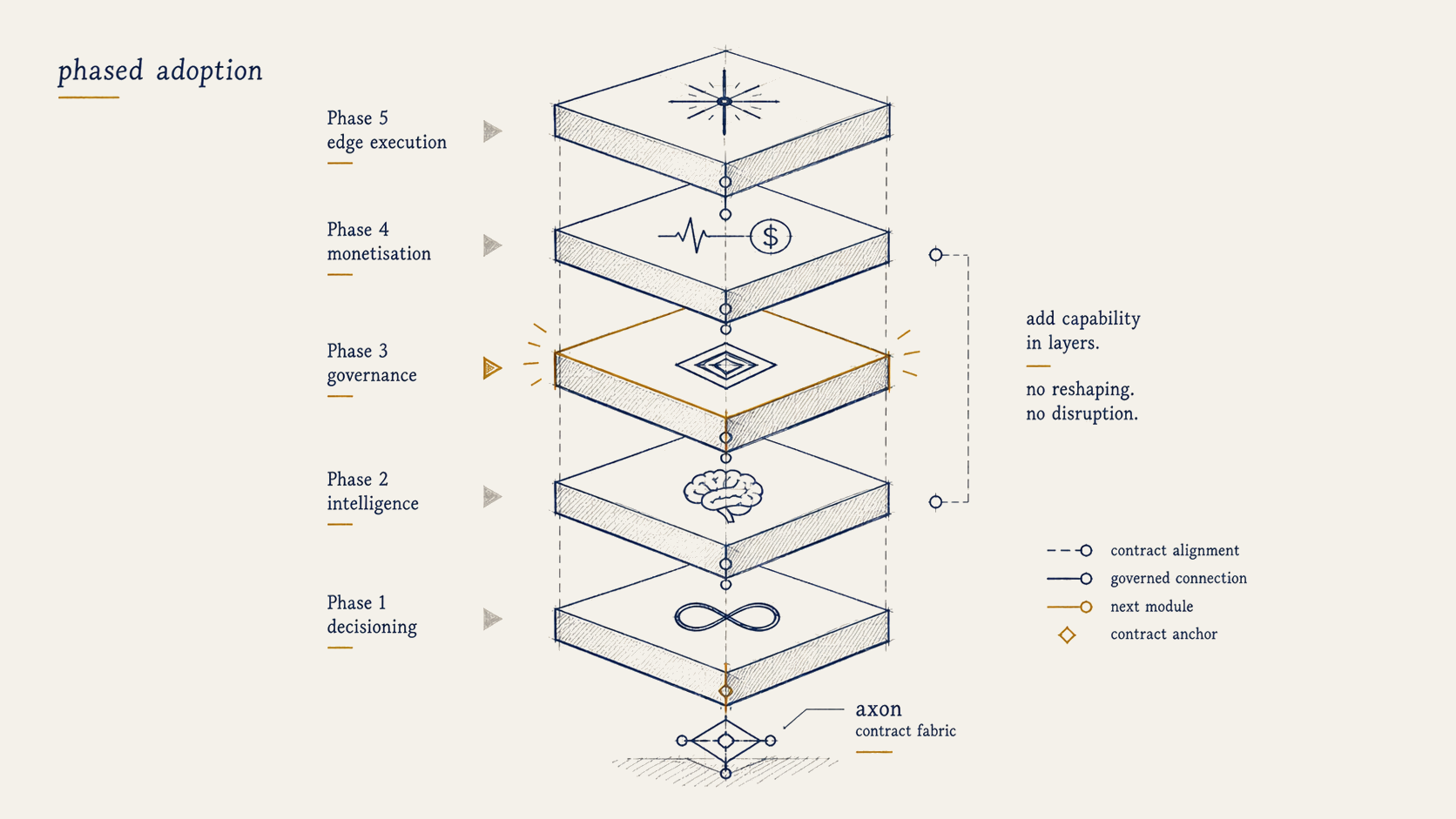
Module-by-module migration
Adopt modules based on business priority. Start with monetisation, or CVM, or partner operations. Add the rest as the business case proves out. Coexists with legacy BSS during transition.
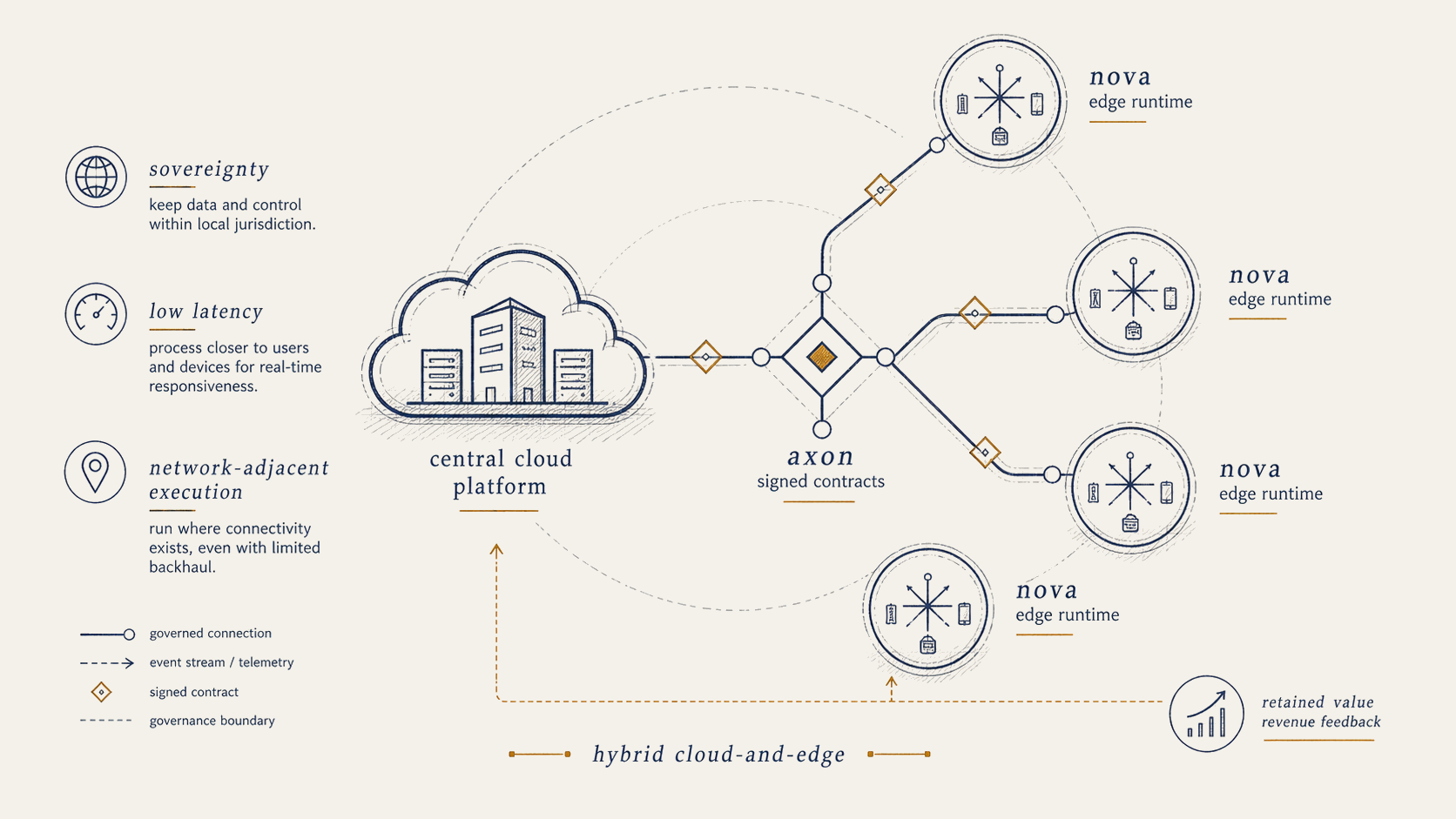
Hybrid cloud-and-edge
Central cloud platform with nova edge runtimes for network-adjacent execution. Where regulatory or sovereignty requirements demand it. Or where latency matters more than centralisation.
Execution-grade outcomes
What you can actually run on it.
Six things that change when intelligence, decisioning, billing, and execution share one platform.
Stop reconciling between systems
Customer events, revenue events, and edge events flow through one sequence. No nightly batch to chase mismatches.
Change a price and have it live tomorrow
A new tariff is a catalogue change, not a release cycle. The commercial team moves at configuration speed.
One customer, one view
Care, self-service, the app, and the bill read the same record. No more chasing four systems for one answer.
Charge in real time, or not at all
Rating happens in the same engine that takes the order, not in a batch reconciliation the next morning.
Stop maintaining point-to-point glue
Modules talk through axon's signed contracts. Adding a module doesn't break the others.
Take AI out of the dashboard and into production
cortex proposes, netra approves, nova executes. Every automated action on the record.
Ready to talk operating model?
Tell us what you’re trying to launch, monetise, or modernise. We’ll point at the part of fullCIRCLE NEXT that earns its keep first, and the migration path that gets you there safely.