Keep and grow customers·nfinity·Customer value management
The advisory shift isn’t just changing how you get found.
It’s changing how you keep customers.
Buyers used to search. Now they ask for advice. The visibility game is becoming a recommendability game. And the operators who win it will be the ones whose customer relationships are already legible to an intelligent system, in real time.
That isn’t traditional CVM. Traditional CVM is campaigns and segments and quarterly reviews. What recommendability needs is something different. Continuous. Auditable. Built to act, not just to score. We built it. It runs on the nfinity decisioning engine. cortex does the inference. netra holds the governance gates. And it ships with the audit trail regulators are about to start asking for. Every decision, every input, every approval, every execution captured in the format your compliance function already uses, inside the perimeter your regulator has drawn around the customer record.
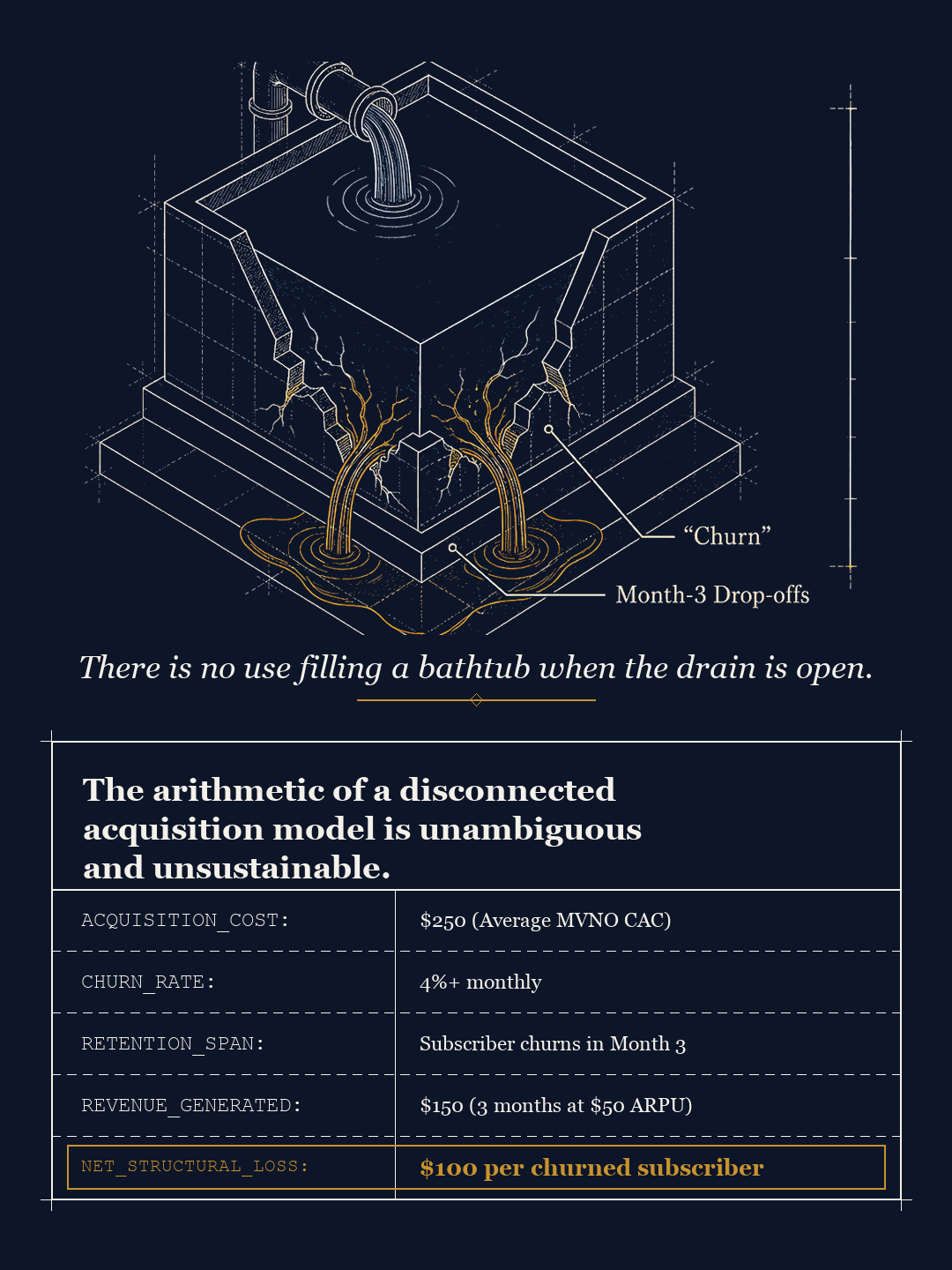
The traditional CVM problem
Campaigns don’t compound.
Decisions do.
Traditional CVM is built around the campaign as the unit of work.
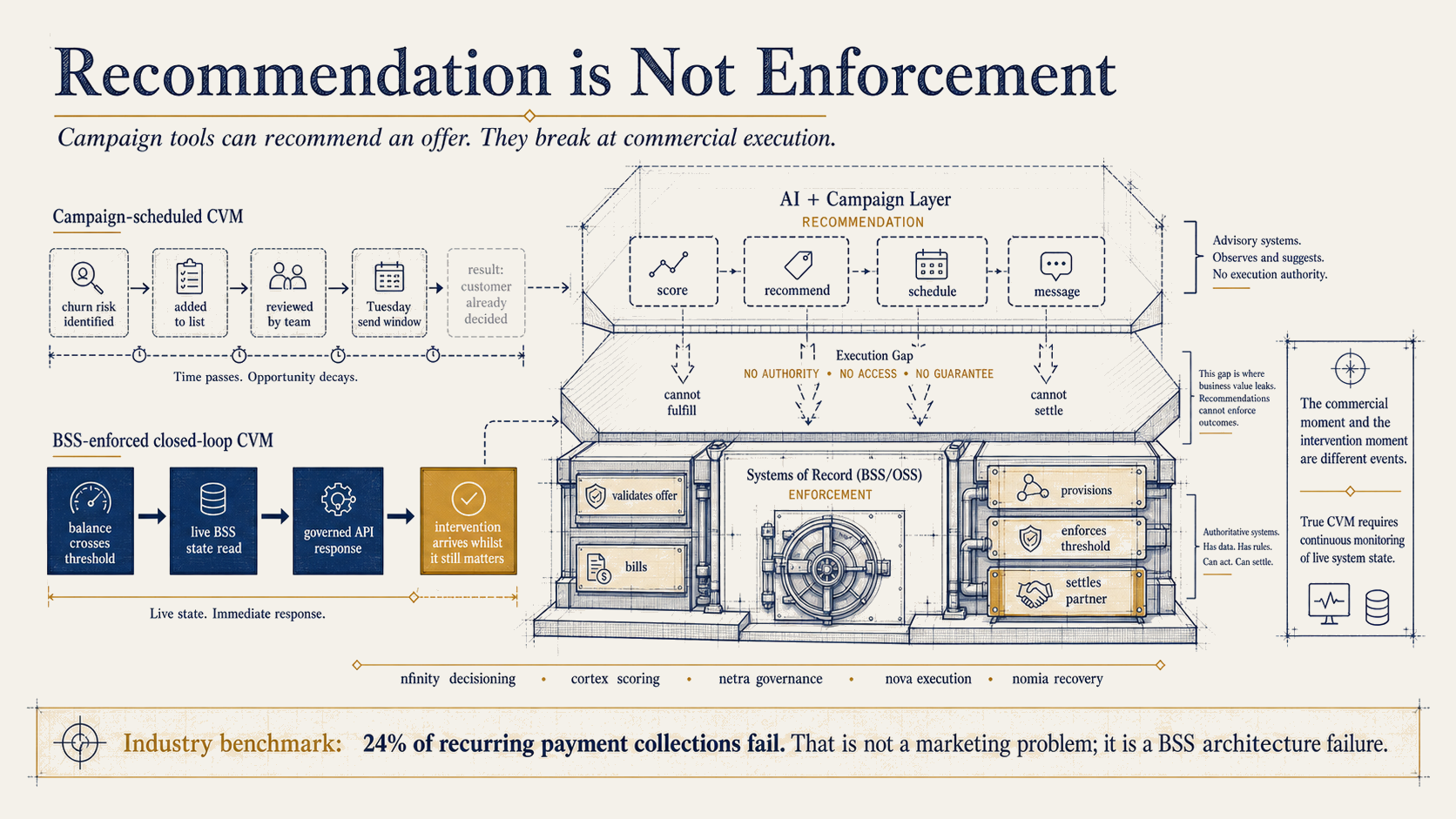
Recommendation is not enforcement. A campaign engine can score a customer, but it cannot execute a balance waiver.
The model assumes the customer state is stable enough to act on a 30-day-old snapshot. It assumes the next-best-action is something a planner can decide in advance.
Neither assumption holds in 2026. Customer state changes by the hour. The next-best-action follows what’s happening now, not what a planner wrote down last quarter.
And the regulator increasingly wants to know, for every offer, every retention move, every algorithmic decision, exactly why it was made. Black-box ML can’t explain itself. Rules engines can’t keep pace. Campaign CVM never even asks the question.
“The agentic era doesn’t change what CVM is for. It changes what CVM has to be made of.”
Governed CVM on fullCIRCLE NEXT
Three modules carry the work.
Each one holds a clean boundary.
CVM on fullCIRCLE NEXT runs as its own application. nfinity is the commercial decisioning engine that hosts it. cortex does the inference. netra holds the governance gates, with every approval logged against the operator who made it. And every decision the system produces can be explained to a regulator, an auditor, or the customer.
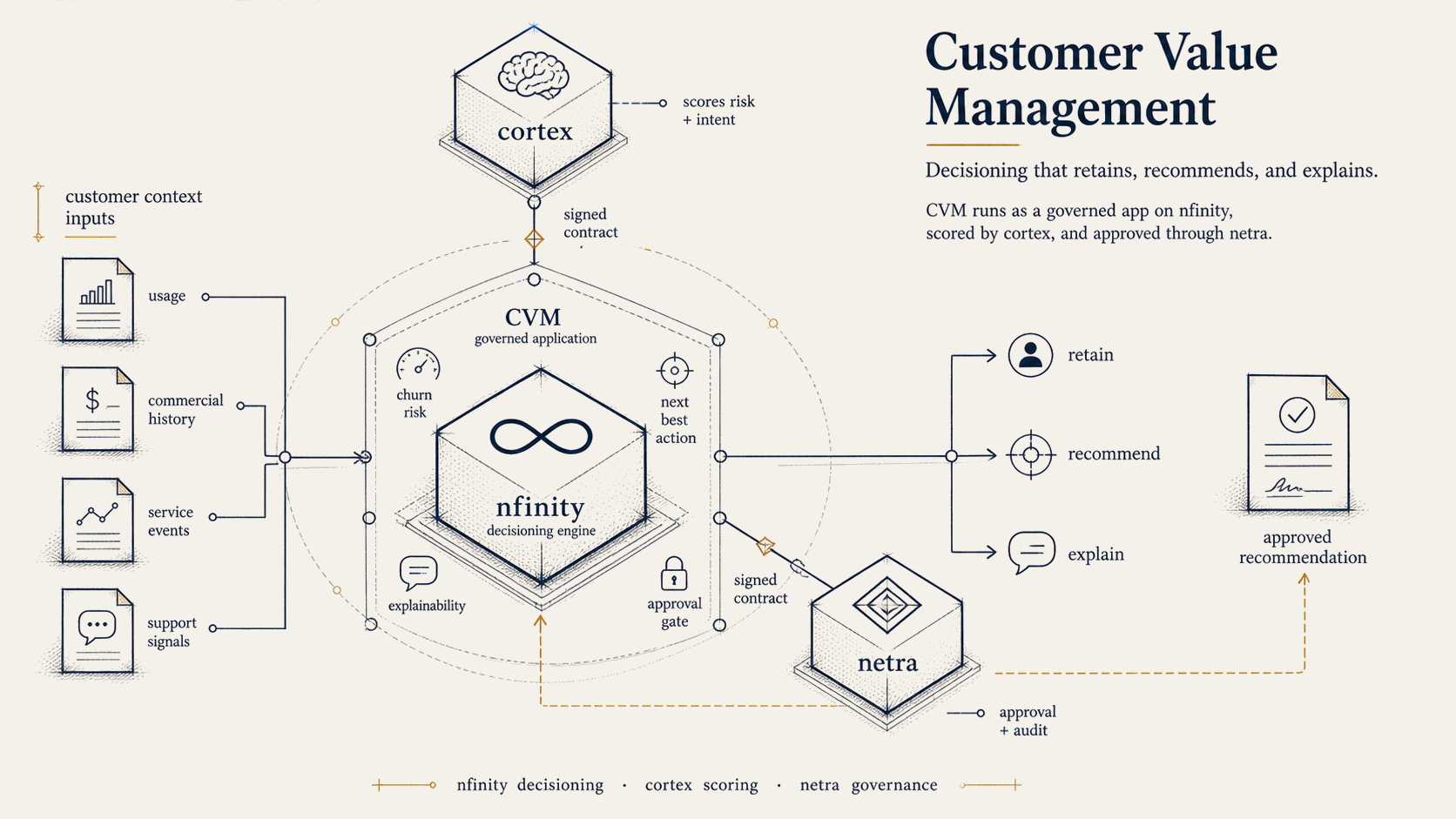
The distinction is not cosmetic. It is the difference between a tool that suggests and a system that executes.
cortex
The inference layer
cortex does the inference. When you score churn risk, rank next-best-actions, or analyse propensity, that work happens here. cortex itself doesn’t need to know what any of it means commercially. Under the hood it picks the right provider and the right model for the task. Gemini, Claude, OpenAI all work. Local models are preferred for these workloads.
nfinity
The decisioning engine
nfinity owns the CVM domain. Churn risk semantics live here. So do cohort-targeted retention strategies, eligibility rules, and rollout configuration. When a decision needs inference, nfinity calls cortex. When a decision needs human sign-off, it goes through netra. CVM, as an operator would run it, is one of the applications hosted here.
netra
The governance layer
Anything that changes customer state stops at netra’s gate first. That includes a retention offer, a balance adjustment, a campaign commit. Each one waits until someone signs off, or until a pre-authorised policy clears it. The audit log captures every decision with the actor’s name on it. Regulators can see exactly what happened. Compliance has the evidence to defend it.
Three modules, one application, and nothing in it you can’t explain when asked.
What the application actually does
Six things traditional campaign CVM can’t do.
CVM as a governed app gives operators six capabilities that campaign-driven CVM cannot. Each one is a primitive in the nfinity domain engine. Together they move CVM from segment-driven to decision-driven.
Real-time customer state
Customer state isn’t a snapshot. It’s a live signal composed from billing, usage, support, and engagement events flowing through axon contracts. Every decision is made on current state, not last quarter’s data.
Explainable next-best-action
Every recommendation carries its reasoning. cortex provides the inference; nfinity attaches the explanation. Operators see why an offer was suggested. So can the regulator.
Cohort-targeted strategies
Retention strategies are defined as cohort + treatment + eligibility + rollout policy. Reusable. Versionable. Auditable. Not a campaign per quarter, a strategy library per market.
Staged rollout discipline
New strategies don’t ship to 100% of the base. They ship to 10%, then 25%, then 50%, then full exposure, with deterministic SHA-256 scope hashing so the same customers stay in the same cohort across stages. Guard rails halt the rollout if metrics drift.
Governance gates
Every action that mutates customer state pauses at a netra approval gate where policy requires it. AI agents can propose; only humans (or pre-authorised policies) can commit. Every approval is signed and logged.
Decision provenance
For every offer, retention move, or scoring decision: what data was used, which model ran, what was returned, who approved, when it executed. Replayable, exportable, regulator-ready.
Try it yourself
See it run for your operator profile.
The Two-Loop Value Simulator lets you compare acquisition-only growth against governed CVM compounding. Run your operator profile, tweak the levers, watch the curves diverge.
The governed agent run
What happens when a CVM agent suggests an action.
This is the pattern under every CVM decision on fullCIRCLE NEXT. Four steps. Two phases. One governance gate that prevents the system from doing anything an operator hasn’t explicitly approved or pre-authorised.
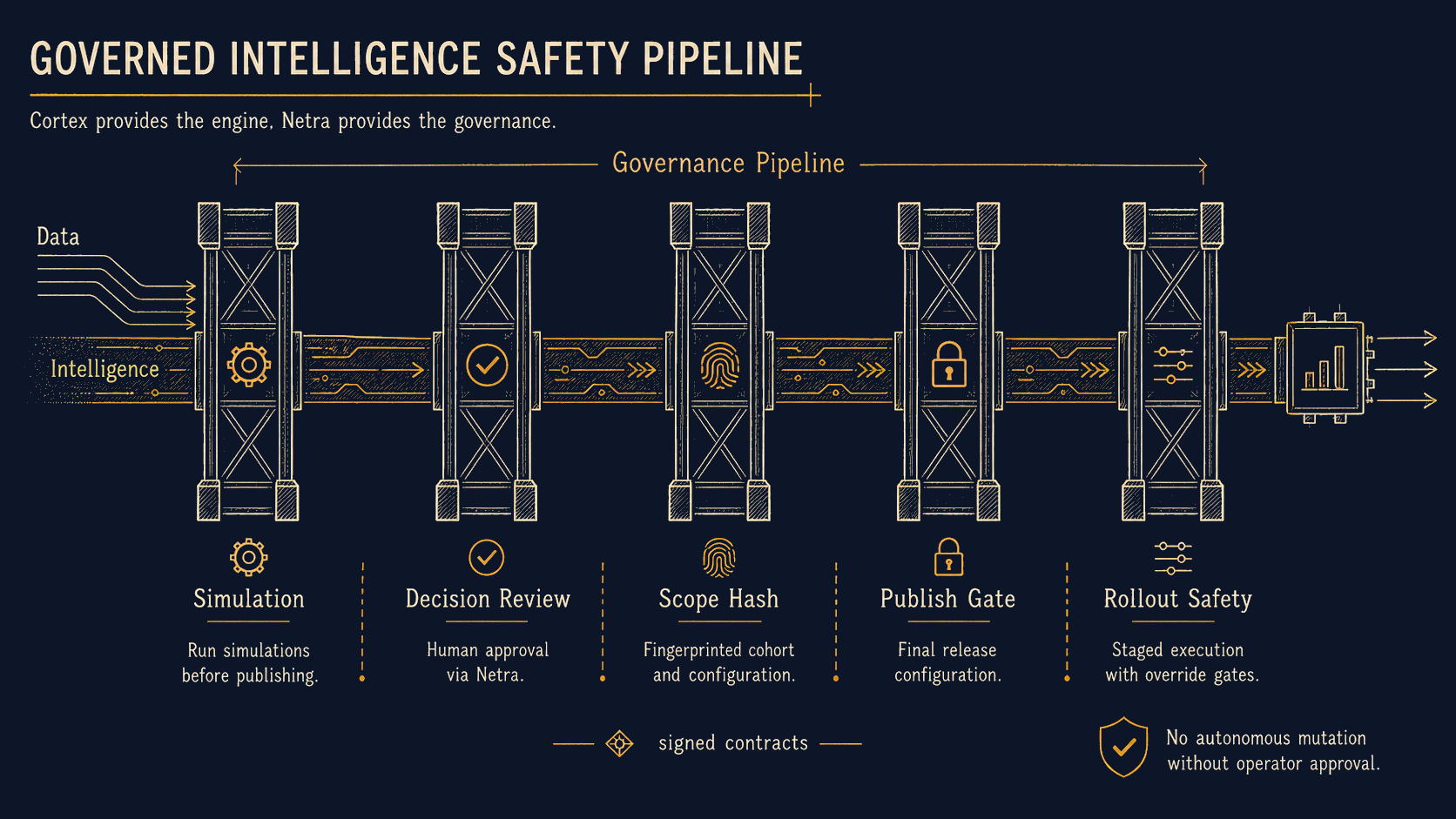
Every action is audit-logged. Every approval has a name on it.
Step 01
cortex analyses customer history (provider call).
Step 02
cortex queries recent billing data from nomia through a read-only, allowlisted plugin.
Step 03
The agent proposes a mutating action. For example, adjusting a retention offer in orbis. The run pauses.
Step 04
An approval request is generated in netra. Explicit operator approval is required before cortex resumes and executes the mutation.
Why this compounds
Two loops. Only one of them scales.
Every operator has two loops. The acquisition loop: gross adds, conversion, cost per acquisition. The value loop: retention, ARPU uplift, lifetime extension.
Most operators over-invest in the first and under-invest in the second. The math is brutal: a 1% reduction in monthly churn typically compounds to a larger NPV than a 10% reduction in acquisition cost. But only if the value loop is actually working. Which means acting on customer state in real time, with governance, at production scale. Most CVM stacks were not built for that.
Campaign-driven CVM cannot deliver it. Governed CVM on fullCIRCLE NEXT can. The whitepaper makes the case. The simulator lets you run it against your own numbers.
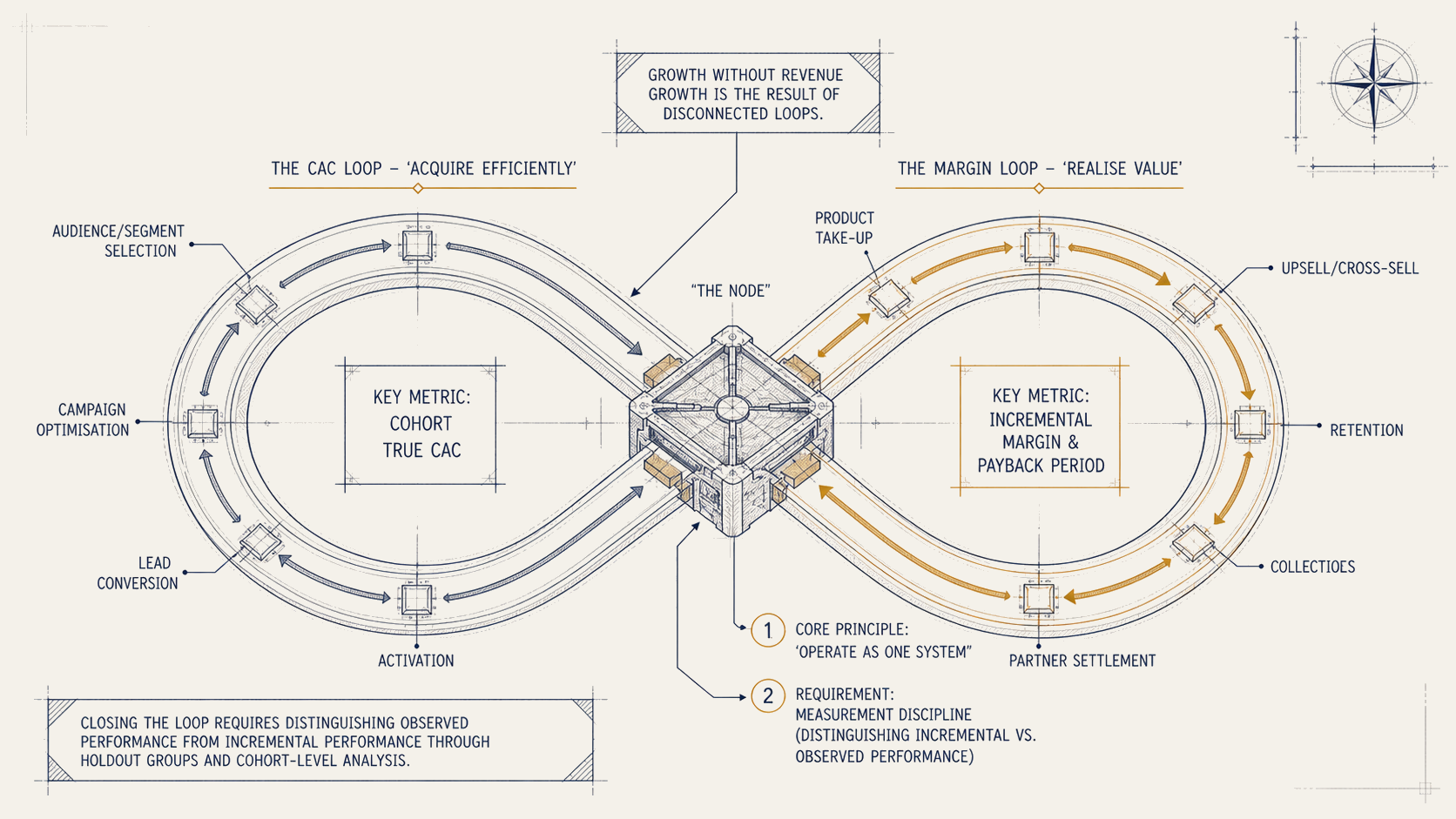
Gesture, not claim. Run the simulator for real numbers.
Next step
The full argument lives in the CVM Showcase.
The whitepaper. The simulator. The decision walkthrough. The maturity audit. Everything we’ve built around governed CVM lives in one place. It’s open. It’s interactive. Walk in.
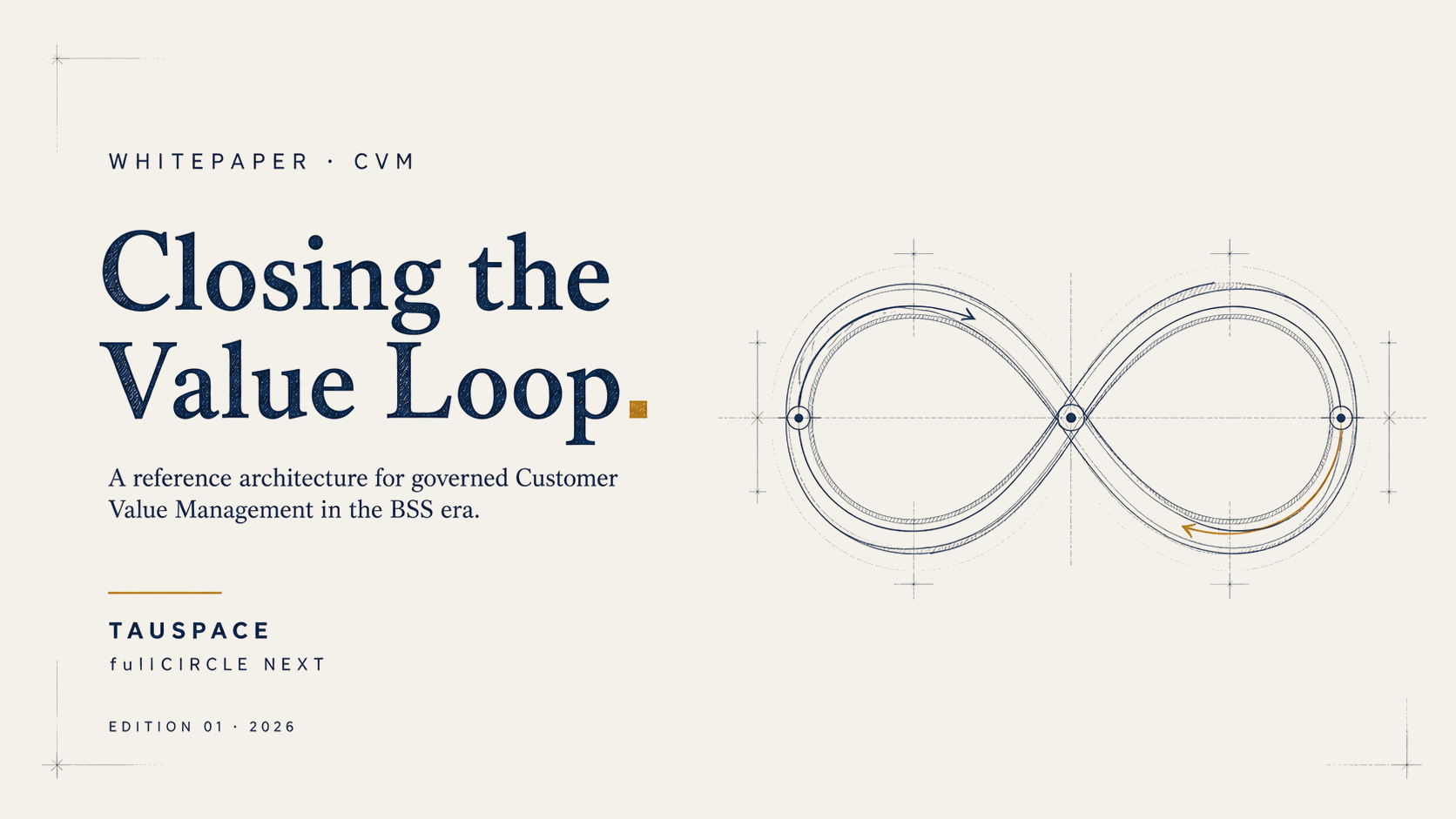
Whitepaper
From CAC to Margin
The full architectural and commercial case for governed CVM. ~40 pages. Read online or download as PDF.
Read the whitepaper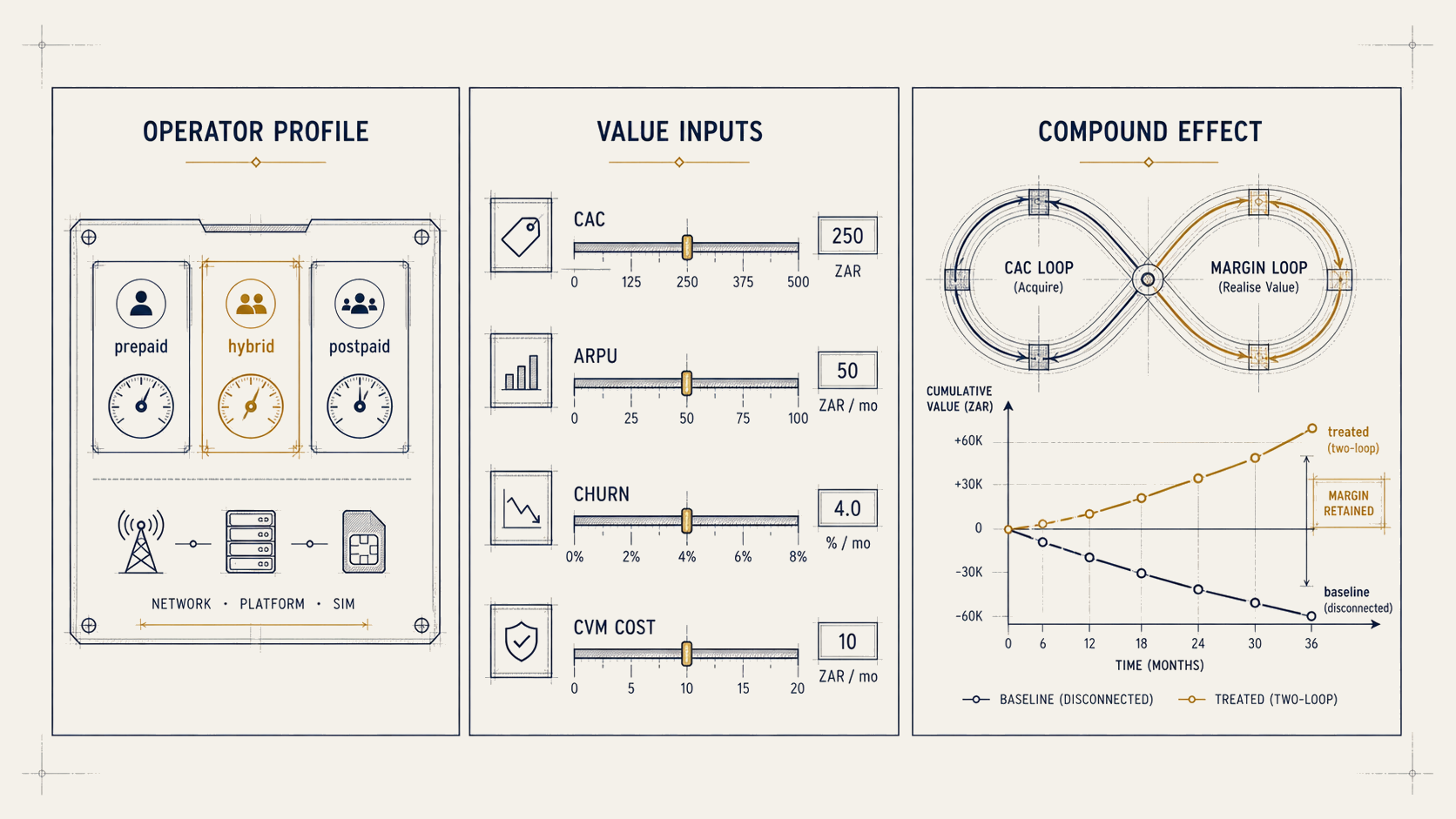
Interactive
Two-Loop Value Simulator
Pick your operator profile. Tweak acquisition cost, ARPU, churn, CVM treatment cost. See the compound effect in real time.
Run the simulator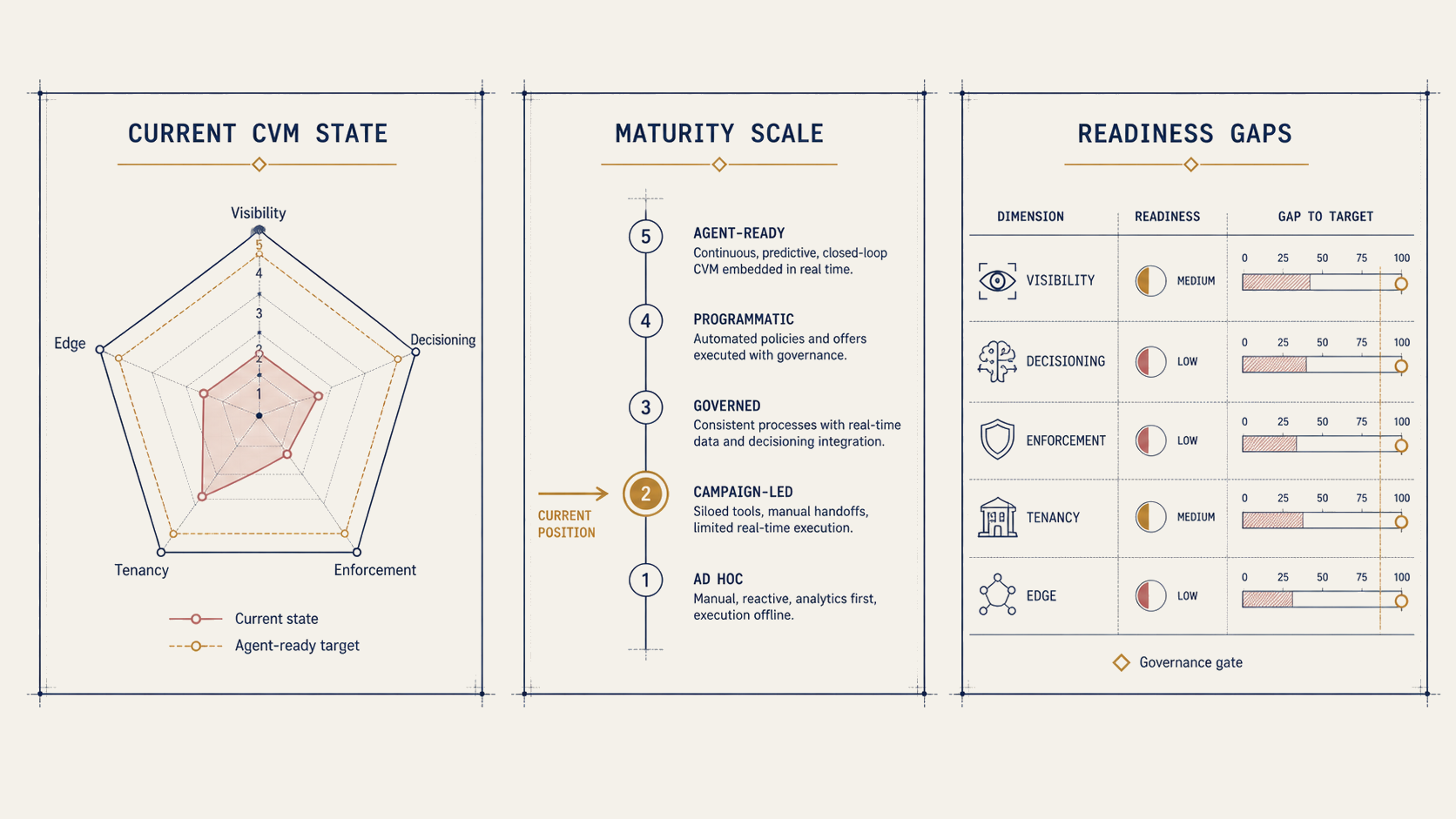
Self-assessment
CVM Recommendability Audit
Five-minute diagnostic. Find out where your current CVM sits on the campaign-to-agent-ready maturity scale.
Take the auditThe architecture underneath
CVM is an app. The platform is the point.
CVM is one of two applications running on nfinity today. Advance.ME is the other: a prepaid service advance with the same governance pattern, the same cortex inference, the same netra approval gates.
That’s the architecture. The applications change. The pattern holds.
If you want to understand the operating fabric beneath CVM, the seven modules, the contract seam, the multi-tenant governance model, start with fullCIRCLE NEXT.
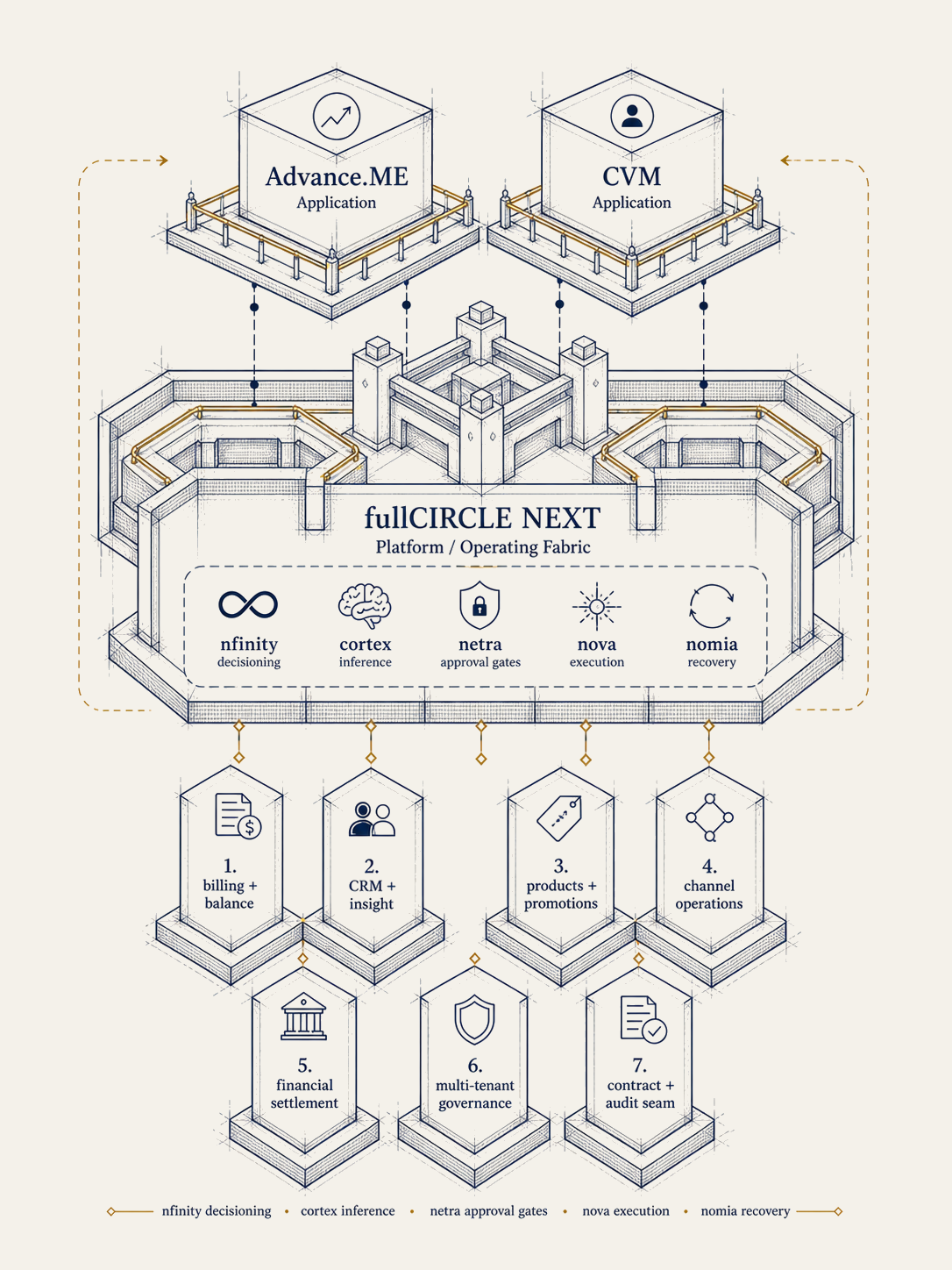
Closing the loop requires execution logic to live inside the system that enforces it.
The advisory shift is happening to your customers, too.
This change doesn’t only affect how companies manage their customers. It changes how customers choose their providers. The operators who make their customer relationships legible to an intelligent system, with governance the regulator will accept and explanations the customer can read, are the ones who become recommendable in their own market.
We built the application for that. The whitepaper makes the case. The simulator lets you run the numbers. The Showcase is open.