Charging & Policy · nomia · Real-time
Stop revenue leakage. Charge in real time. Enforce policy in the same breath.
Unified charging & policy control.
Most operators run charging and policy as separate systems bolted together with batch reconciliation between them. That gap is where revenue leaks and where the network and the commercial model fall out of sync. nomia closes it. One in-memory core runs the Converged Policy Manager and the Rating and Charging Engine together, so the decision to allow a session and the decision to charge for it are the same decision, made in milliseconds.
The split-stack problem
When charging and policy disagree, the operator loses both ways.
A subscriber starts a session. The policy system says they are entitled to it. The charging system, running off a stale balance, either blocks a paying customer or lets a zero-balance session run free. Either way the operator loses: a blocked customer churns, an unbilled session is pure leakage. The cause is structural. Policy and charging were built as separate systems, and the reconciliation between them runs in batch, hours or days later.
In a prepaid, high-churn market the gap is fatal. Balances move by the second. Sessions start and stop in real time. A charging decision made against a balance that is even minutes old is a charging decision made against fiction. The only fix is to make policy and charging the same real-time decision against the same live balance.
“The decision to allow a session and the decision to charge for it should be one decision, not two systems arguing after the fact.”
One in-memory core
CPM and RCE, on the same engine.
nomia runs two engines on one in-memory core. The Converged Policy Manager decides what a subscriber is entitled to. The Rating and Charging Engine decides what it costs and deducts it. Because they share the same in-memory balance state, the entitlement decision and the charging decision happen together, in a single sub-millisecond lookup, against a balance that is current to the moment.
Converged Policy Manager (CPM)
Real-time policy decisions: entitlement, eligibility, quota, fair-use, and threshold actions. Evaluated in memory at the moment of the session, not pulled from a slow external policy store.
Rating & Charging Engine (RCE)
Real-time rating and charging against live in-memory ETS balances. Sub-millisecond tariff lookups. Prepaid, postpaid, and hybrid on one engine, with a single subscriber wallet across every interface.
One core. One balance. One decision.
Across every generation
One engine. Three protocols. Every network you run.
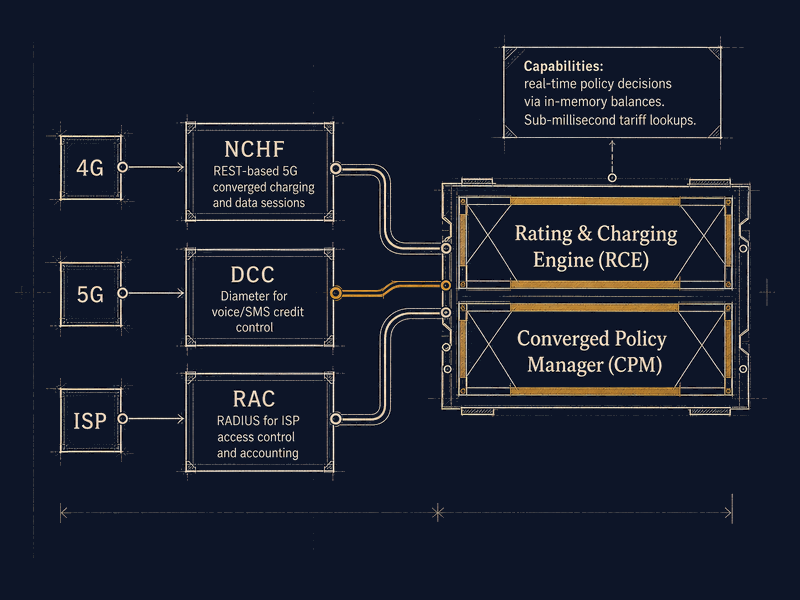
nomia speaks to the network through three protocol adaptors, so the same charging core serves 5G, 4G, voice, SMS, and ISP access without a separate billing silo per generation.
5G converged charging
NCHF (5G)
REST-based converged charging and data sessions for the 5G core. Standards-aligned converged charging (Nchf) for real-time session authorisation and quota management on standalone 5G.
Diameter credit control
DCC (4G / voice / SMS)
Diameter credit control for voice, SMS, and 4G data. Real-time credit authorisation over the established Diameter interfaces operators already run.
RADIUS access control
RAC (ISP)
RADIUS for ISP access control and accounting. Brings fixed, FWA, and ISP charging onto the same engine as mobile, so converged operators bill one way, not three.
The protocol changes. The engine doesn’t. The same rating, the same balances, the same policy core serves every access type.
Anatomy of a charged session
From session request to deducted balance, in milliseconds.
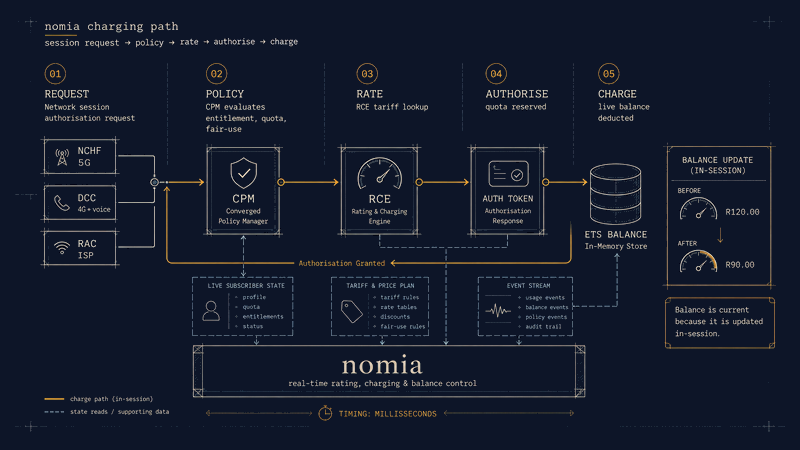
The path a single chargeable event takes through nomia. No batch. No reconciliation lag. The balance is right because it was never allowed to be wrong.
Step 01
Request
The network requests authorisation for a session (NCHF for 5G, DCC for 4G and voice, RAC for ISP).
Step 02
Policy
CPM evaluates entitlement, quota, and fair-use against live state, in memory.
Step 03
Rate
RCE rates the session against the live in-memory ETS balance with a sub-millisecond tariff lookup.
Step 04
Authorise
nomia returns the authorisation and reserves the quota. The session proceeds.
Step 05
Charge
Usage is deducted from the live balance in real time. The balance is current the instant the session ends.
Wholesale and retail on one engine
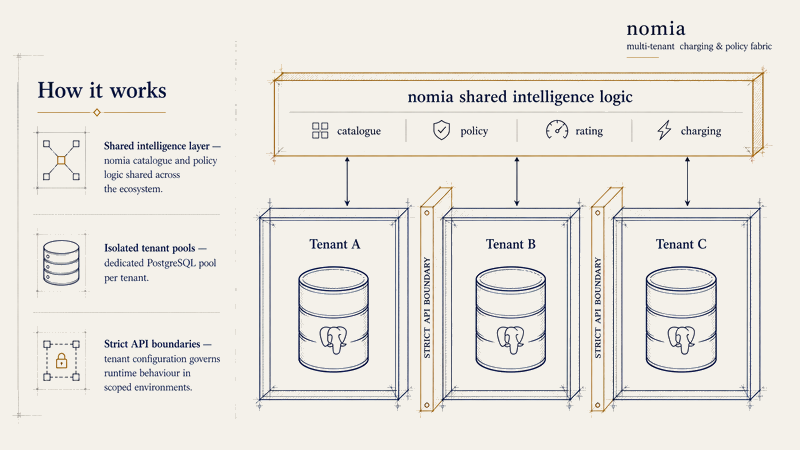
Every tenant charged in isolation, on shared infrastructure.
Operators running retail, wholesale, and MVNE divisions need each tenant’s charging fully isolated: no balance bleed, no cross-tenant visibility, no shared rating tables that one partner can see into. nomia enforces tenancy at the database layer. Each tenant runs in its own dedicated pool (TenantNomiaPool), with strict API boundaries governing what crosses between them. One charging engine serves the whole ecosystem; the isolation is architectural, not a configuration flag.
For the full multi-tenancy and edge-isolation model, see Deployment
Governed monetisation
Charging is where mistakes cost real money. So it’s governed.
A charging engine that can be changed without control is a liability. On fullCIRCLE NEXT, changes to rating, policy, and tariff flow through the same governance the rest of the platform uses. cortex can propose a tariff or policy change. The change pauses at a netra approval gate. Only after operator approval does it go live. Every rating decision and every policy change is audit-logged with actor attribution.
This is the governance triad applied to money: netra decides, cortex reasons, nova executes at the edge where charging meets the network.
What you can run on it
Charging that keeps up with the commercial model.
Real-time prepaid
Charge to the second against live balances. No overspend, no blocked paying customers.
Converged billing
5G, 4G, voice, SMS, and ISP on one engine, one wallet, one bill.
Hybrid models
Prepaid and postpaid on the same subscriber, the same engine, no separate stack.
Partner settlement
Revenue splitting and partner economics built into product definitions, settled accurately.
Threshold actions
Balance-triggered offers, top-up prompts, and fair-use actions fired in real time by CPM.
Sub-millisecond scale
Tariff lookups against in-memory ETS balances, built for high-concurrency session volumes.
Bring charging and policy into one real-time decision.
Tell us what you’re charging for, across which generations, at what scale. We’ll show you how nomia unifies it, and where it fits against the core and charging stack you run today.