
Capture the zero-balance moment·nfinity·Prepaid service advance
The zero-balance moment doesn’t have to be a churn event.
Advance.ME makes it a value moment.
Prepaid customers run out of airtime at the worst possible times. Mid-call. Mid-stream. Mid-day. For the operator, that moment is either a lost session or a captured one. Which one depends entirely on whether the system can recognise the signal, score the customer, present a governed offer, and execute it in seconds.
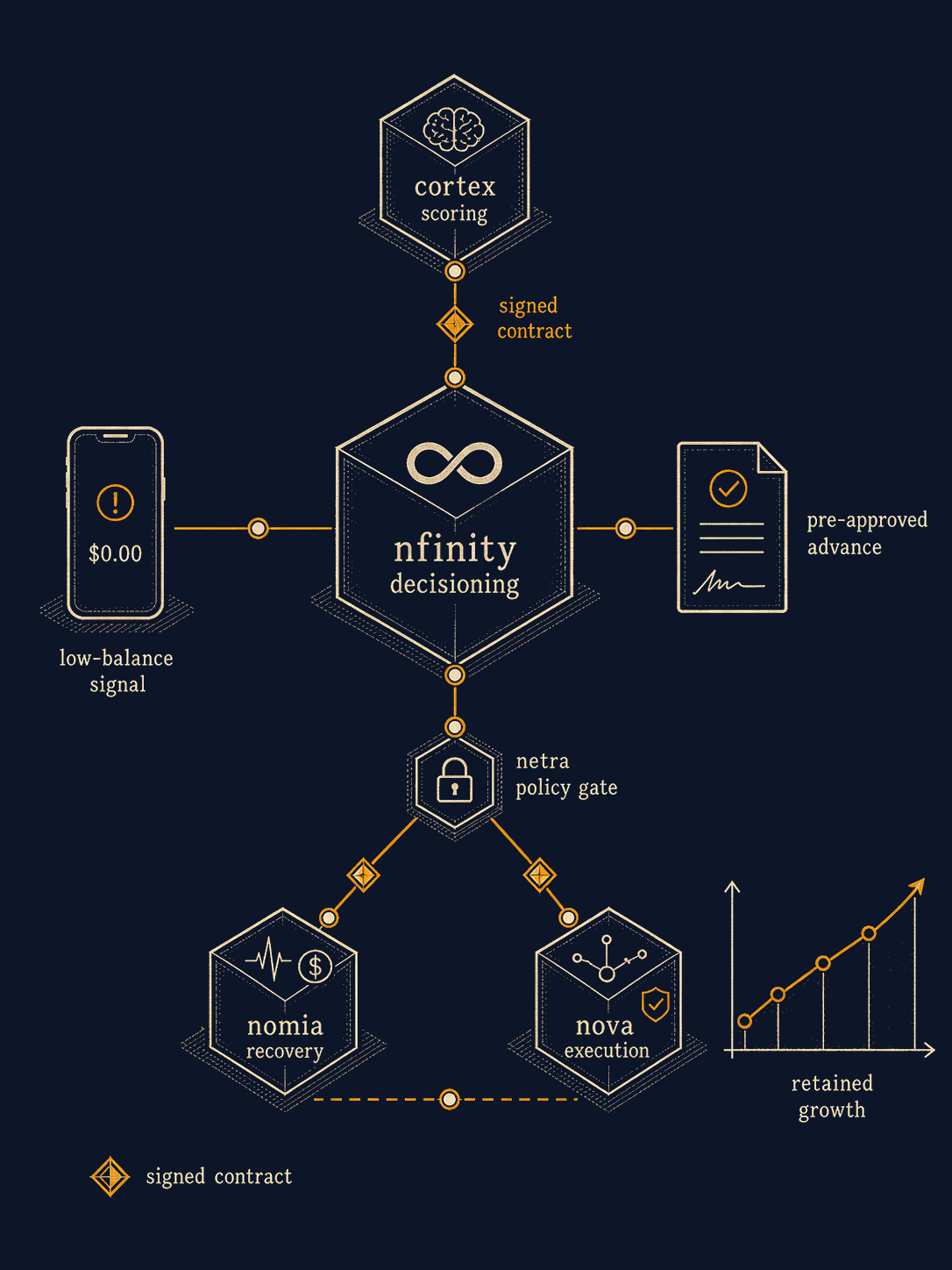
Advance.ME is the application that does that. It runs on nfinity, the platform’s commercial decisioning engine. cortex scores. netra governs. nomia and nova execute. And it ships with the audit trail to keep regulators, your finance team, and your customers on the same page about what it is: service access with a flat facilitation fee, not a loan. The agent that scores the moment runs in your environment, on data that never crosses a border the regulator hasn’t approved.
The positioning
A service advance.
Not a loan.
Advance.ME is positioned, structured, and operated as a prepaid service advance. The customer receives early access to airtime, data, or service. The facilitation fee is flat, disclosed up front, and recovered automatically at the next top-up. No interest accrues. The fee is fixed, not time-based. No debt is created. The advance settles in a single recovery at the next top-up, not a balance that compounds. And there’s no credit assessment. The operator’s own eligibility check is the only gate.
That distinction matters commercially and regulatorily. Loan products carry regulatory weight: credit licences, interest disclosure, recovery obligations, default handling. Service advances don’t. The product is sold to the customer as what it is. A small extension of service they’ve already chosen to consume, in exchange for a flat fee paid back when they next top up.
The whole architecture, eligibility, governance, audit, recovery, is designed to preserve that distinction at scale.
“Early access to telecommunications service with a flat facilitation fee.”
Two modes, one engine
The platform meets the customer at the moment of need.
Advance.ME operates in two modes. Customer-initiated, where the customer requests an advance through whatever channel they have to hand. Operator-initiated, where the platform detects the moment, scores the customer, and presents a pre-approved offer through the right channel at the right time. Same engine. Same governance. Different trigger.
The intelligent mode
Operator-initiated
The platform detects. The customer decides.
The signal of a near-zero balance reaches the platform in real time through nomia. cortex scores the customer on advance eligibility, propensity to accept, and likely recovery success. nfinity selects the right offer (amount, fee, channel) for that customer at that moment. The offer goes out through USSD, SMS, IVR, app, or in-bill notification, whichever channel the customer has been most responsive to. Acceptance triggers immediate provisioning. Recovery happens automatically at the next top-up.
- Low-balance signal detection through nomia
- Real-time eligibility scoring via cortex
- Channel selection optimised per customer
- Governed offer presentation through netra-approved policies
- Automatic recovery via nomia at next top-up
The requested mode
Customer-initiated
The customer asks. The platform answers.
A customer can request an advance directly through a USSD short code, SMS, IVR menu, self-service app, or even in-call. nfinity scores eligibility in real time. The advance, if approved, is provisioned within seconds. Recovery is automatic at next top-up. No call-centre intervention. No paperwork. No queue.
- USSD, SMS, IVR, and app request channels
- Real-time eligibility check
- Sub-second provisioning
- Same recovery and audit pattern as operator-initiated
Governed execution on fullCIRCLE NEXT
The work splits clean.
Three modules decide. Two execute.
Advance.ME is an application running on the same architectural pattern as the rest of the platform. Three modules carry the commercial decisioning. Two more carry the execution.
cortex
The scoring layer
cortex scores eligibility, propensity, and likely recovery success in real time. Provider-agnostic inference with model selection by task class. The high-frequency eligibility decision uses a different model than the lower-frequency portfolio-level analytics.
nfinity
The application layer
nfinity hosts the Advance.ME application logic. Eligibility rules, offer sizing, fee structures, channel policies, exposure controls, recovery configurations. Same decisioning engine that hosts CVM, applied to a different commercial surface.
netra
The governance layer
Policy gates on every advance offer: exposure caps per customer, per cohort, per portfolio. Audit trail with the actor’s name on every decision. When a recovery doesn’t clear at the next top-up (rare, but the platform handles it), the escalation flows through netra with full provenance.
nomia
The monetisation layer
Provisions the advance balance, charges the facilitation fee, recovers automatically at next top-up. Real-time, in-memory, no batch.
nova
The edge layer
USSD, SMS, IVR termination. Vendor-specific adapters for offer delivery and acceptance. Site-local execution means customer credentials and session state stay behind the operator firewall.
Five modules. One governed application. Sub-second execution from signal to provisioning.
Anatomy of an advance
From signal to provisioning, in seconds.
The end-to-end flow of a single operator-initiated advance. Six steps. Two governance touchpoints. One customer experience that feels like the operator is paying attention.
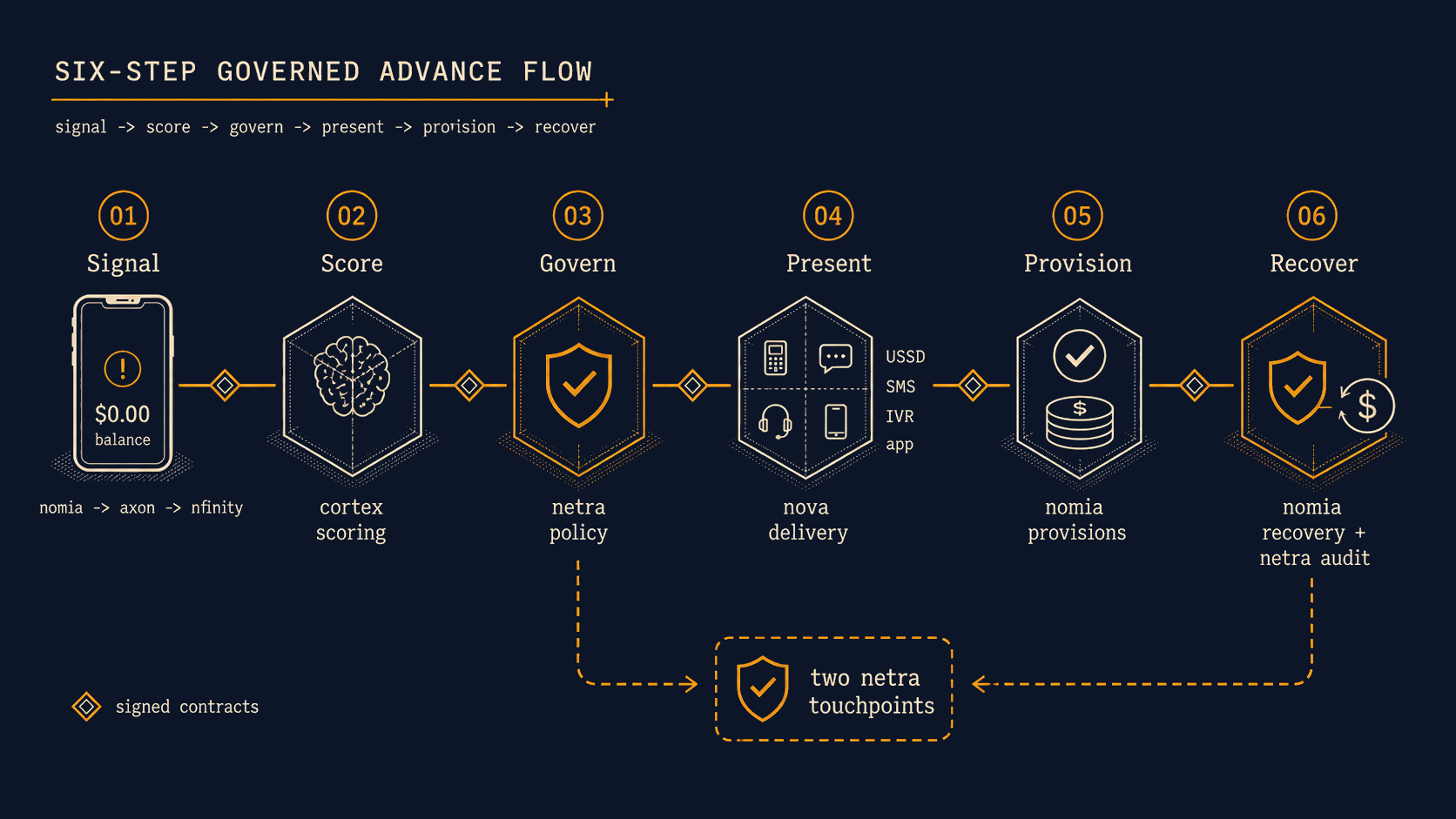
Every step is audit-logged. Every offer sits inside a policy. Every recovery runs without a human in the loop.
Step 01
Balance signal reaches the platform
A customer’s balance crosses the operator’s defined threshold. nomia emits the signal through axon to nfinity.
Step 02
Eligibility and propensity scored
nfinity invokes cortex for real-time scoring. Customer history, recent activity, recovery track record, exposure position, all reasoned over in under a second.
Step 03
Offer composed under policy
nfinity composes the offer, amount, fee, channel, within the policy boundaries set in netra. If the offer exceeds any guardrail, it pauses for operator review.
Step 04
Offer delivered to the right channel
The offer reaches the customer via the channel they’re most responsive to. USSD, SMS, IVR, or app. nova handles the edge delivery.
Step 05
Acceptance triggers provisioning
The customer accepts. nova confirms. nomia provisions the advance balance instantly. The session continues.
Step 06
Recovery at next top-up
When the customer tops up next, nomia automatically recovers the advance and facilitation fee from the new balance. Audit logged through netra.
Why operators deploy it
Three revenue lines from one application.
Operators deploy Advance.ME for three commercial reasons, in roughly this order of magnitude.
The first is the captured session. Customers who would otherwise have run out and disconnected stay on the network. The session continues. The ARPU minute is preserved.
The second is the facilitation fee. Modest per advance, but the volumes are substantial. In markets with high prepaid penetration, transaction volumes scale into the millions per month, and the aggregate fee revenue is material.
The third is the retention signal. Customers who use Advance.ME show meaningfully higher loyalty over time than matched cohorts who don’t. The operator that helps the customer at the zero-balance moment becomes harder to switch away from.
That’s three revenue lines from one application. Underneath, the same fullCIRCLE NEXT architecture that runs everything else.
Gesture, not claim. Actual ordering depends on portfolio characteristics.
Deployment
Built to fit the operator that’s already running.
Advance.ME deploys against the operator’s existing core, charging system, and channel infrastructure. The application sits on fullCIRCLE NEXT; the integrations meet the operator where they are.
nomia integrations
Charging integration
Real-time charging via DCC for 3G/4G, NCHF for 5G, RAC for ISP scenarios. Compatible with the operator’s existing OCS via DIAMETER where required. Per-tenant database isolation via TenantNomiaPool, so each operator’s data sits in its own pool.
nova channels
Edge channels
USSD, SMS, and IVR termination behind the operator firewall. Vendor-specific adapters for offer delivery. Site-local execution means vendor credentials and session state never leave the operator’s environment.
Platform modes
Deployment modes
Available as part of a full fullCIRCLE NEXT deployment, as a phased adoption on top of existing BSS, or as a distributed edge deployment where regulatory or sovereignty requirements demand it.
The architecture underneath
Advance.ME is an app. fullCIRCLE NEXT is the platform.
Advance.ME is one of two applications running on nfinity today. CVM is the other: customer value management with the same governance pattern, the same cortex inference, the same netra approval gates.
That’s the architecture. The applications change. The pattern holds.
If you want to understand the operating fabric beneath Advance.ME, the seven modules, the contract seam, the multi-tenant governance model, start with fullCIRCLE NEXT.
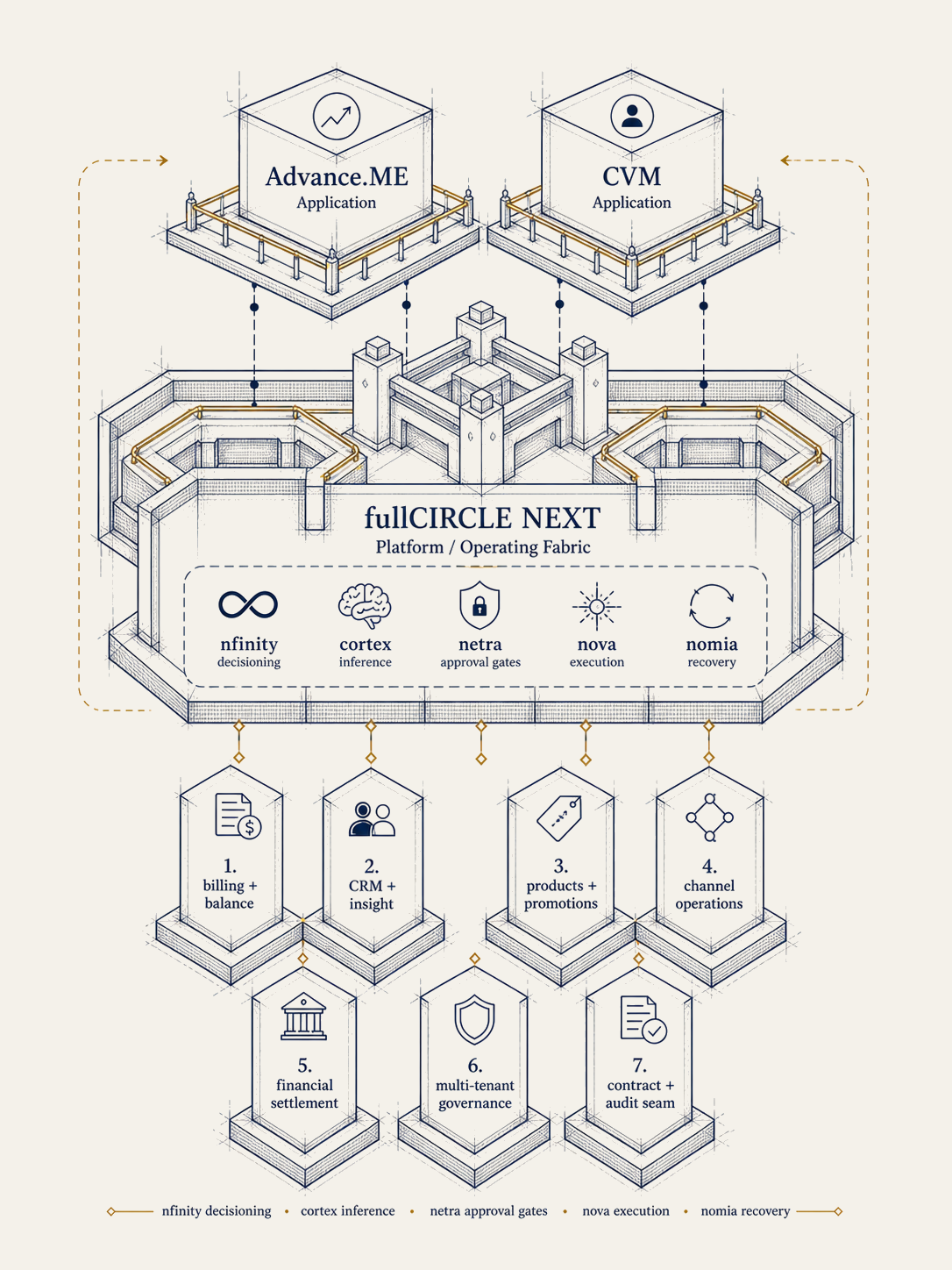
Seven modules. One operating fabric. Advance.ME runs here.
The zero-balance moment, captured.
Advance.ME is in production. The architecture is proven. The commercial model is clear. What’s left is the conversation about your portfolio: eligibility logic, offer policy, channel strategy, recovery profile, regulatory posture.
That conversation is usually a call. Sometimes a workshop.