
Use case · MVNE / Wholesale operators
Onboard MVNOs faster. Operate them consistently.
Every new partner shouldn't be a new integration project.
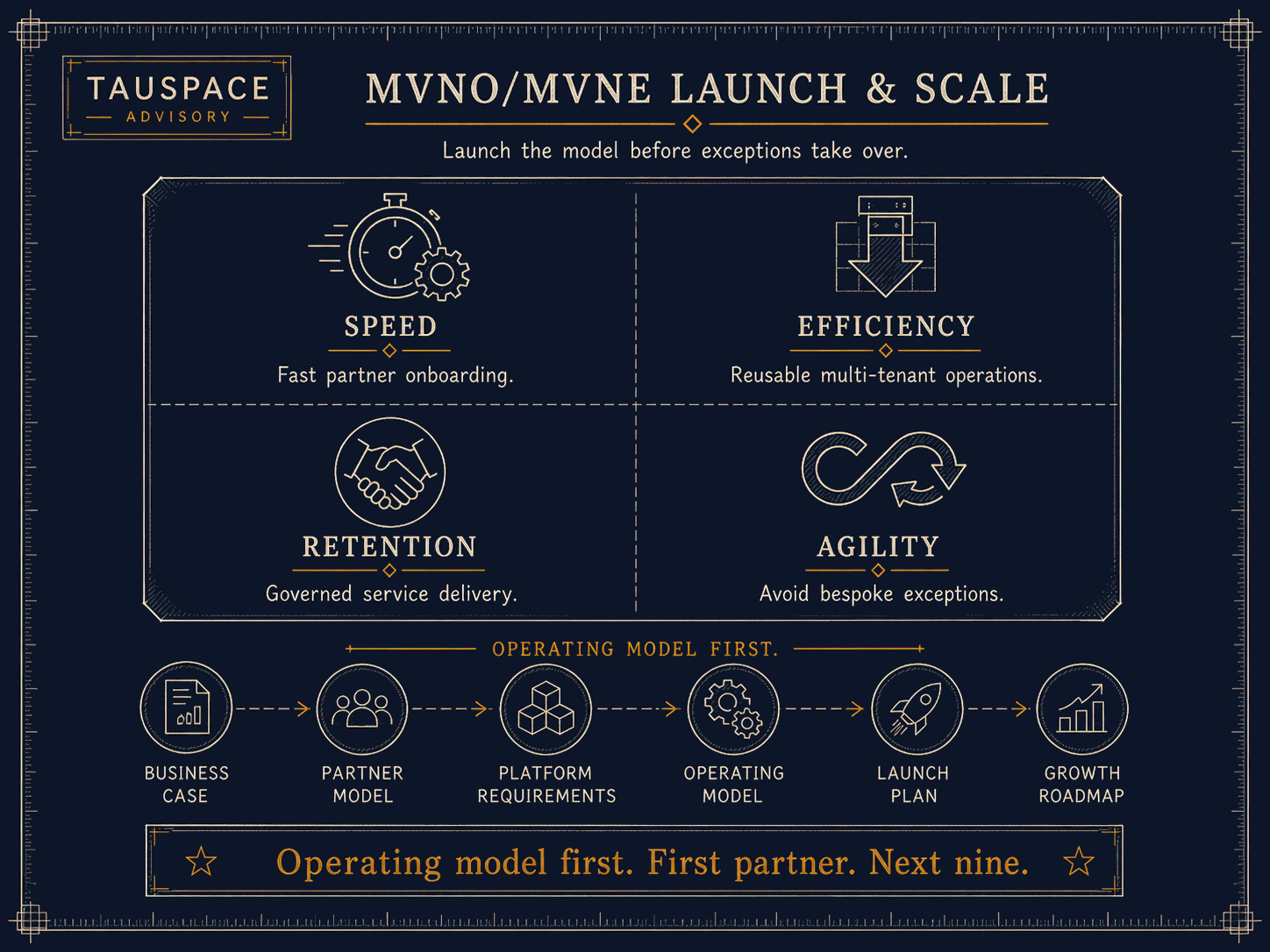
The wholesale business grew, and the operating model didn't grow with it. Each new MVNO arrived with its own configuration, its own billing quirks, its own onboarding cycle, its own reconciliation spreadsheet. The partner book is bigger, but the cost of running it grew faster than the revenue, because the platform underneath was built for one partner and stretched to carry many. This is the journey to a wholesale operation where the next partner is a configuration, not a project.
Where you are
The partner book is growing. The cost of running it is growing faster.
You run a wholesale or MVNE operation, and it works, but the economics are heading the wrong way. Onboarding a new MVNO takes weeks or months because each one needs bespoke configuration and a testing cycle. Billing each partner involves manual steps and a reconciliation process that someone owns in a spreadsheet. Partner performance data lives across several systems, so nobody has a clean view of which partners are actually profitable. The growing compliance and security burden of carrying more partners on shared infrastructure sits on the same stretched team.
The underlying issue is that the platform was built for a single tenant and adapted to carry many. True multi-tenancy isn't a configuration you switch on; it's an architecture. Without it, every new partner adds operational cost roughly linearly, which means scale never delivers the margin improvement it's supposed to.
The real dependencies
Six things that turn partner growth into margin instead of drag.
The goal is sub-linear cost growth: each new partner costing less to run than the last. These dependencies make that possible.
True multi-tenancy
Each partner isolated at the database layer, sharing infrastructure but not data. Not a permission flag; an architectural boundary. nomia's TenantNomiaPool model and the platform's isolated database pools.
Standardised onboarding
Partner templates, standard product models, repeatable launch workflows. The new partner configures into an existing pattern rather than triggering a bespoke project.
Automated rating and reconciliation
Partner billing and settlement automated, not run through a monthly spreadsheet exercise. The single biggest operational cost in most wholesale operations.
Self-service partner portals
Partners managing their own catalogue, customers, and reporting through a portal, rather than raising tickets to your operations team for routine changes.
Partner analytics and governance
A clean, central view of partner performance, profitability, and compliance. The data to manage the partner book commercially rather than just operate it.
Audit and compliance at scale
The governance and audit posture that lets you carry many partners on shared infrastructure without the compliance burden growing partner-by-partner.
The sequence
From bespoke-per-partner to configuration-per-partner.
The journey can run as a migration of the existing partner book or as a clean platform for new partners first. Most operators do both, in sequence.
Phase 1
Map the current cost-to-serve
What each partner actually costs to onboard and operate today, and where the cost concentrates. The MVNO/MVNE advisory and operating model work establishes the baseline.
MVNO and MVNE launch advisoryPhase 2
Stand up the multi-tenant backbone
Operator Suite packages fullCIRCLE NEXT for multi-partner operations: unified catalogue and policy, automated rating and reconciliation, self-service portals, partner analytics, isolated tenancy.
Operator SuitePhase 3
Onboard new partners onto the new model
Prove the standardised onboarding on new partners first, where there's no migration risk. Measure time-to-launch against the old bespoke baseline.
Phase 4
Migrate the existing book
Move existing partners onto the multi-tenant backbone on a schedule, partner by partner, retiring the bespoke configurations as you go.
DeploymentA concrete near-term shape
What the first 90 days can look like.
A common shape, structured to prove the model before committing to a full migration:
- Weeks 1 to 4Current cost-to-serve mapped. The standardised onboarding model and partner templates designed.
- Weeks 5 to 9Multi-tenant backbone configured. One new partner onboarded onto it as the pilot.
- Weeks 10 to 13Pilot partner live. Time-to-launch and cost-to-serve measured against the old baseline. Migration plan for the existing book built from the proven model.
The commitment is to prove the new onboarding model on one real partner before migrating the book, so the business case for the migration is measured, not assumed.
Platform, consulting, experience
The journey in one view.
Platform: Operator Suite
Operator Suite packages the multi-tenant backbone for wholesale operations.
Explore Operator SuiteConsulting: MVNO/MVNE advisory
MVNO and MVNE launch advisory plus operating model design.
See MVNO/MVNE advisoryExperience: live MVNO programmes
Live MVNO programmes hosted on a single platform.
Read the experienceTell us what your partner book is costing you to run.
A wholesale operation where each new partner is a project, billing runs through spreadsheets, and the cost of scale is eating the margin scale was supposed to deliver. That's the starting point, and the fix is architectural.