
Use case · Operators / FWA / Fibre
Launch and monetise a 5G FWA business.
Coverage is the easy part.
5G fixed wireless access looks like a network project and behaves like a commercial one. The spectrum is allocated, the sites are going up, the CPE is on order. Then the questions that actually determine whether the business works arrive: how do you charge for it in real time, how do you enforce fair-use without losing customers, how do you bundle it against your existing fibre, and how do you do all of that without standing up a parallel BSS for one product line. This is the journey from spectrum to a live, billable FWA business.
Where you are
You have spectrum, sites, and a commercial gap.
Most FWA launches start from one of two places. Either you’re a fibre or fixed-line operator adding wireless to reach the homes the fibre won’t economically pass, or you’re closer to greenfield, with a spectrum allocation and a plan to build. Either way, the network side has a clear owner and a clear plan. The commercial side is where the gap usually sits. The existing billing system, if there is one, was built for fixed-line accounts on monthly cycles, not for real-time wireless usage, policy-driven QoS tiers, and the fair-use enforcement that FWA economics depend on.
The gap matters because FWA margins are thinner than fibre and more sensitive to abuse. A handful of customers running unmetered heavy usage on a fair-use plan can erode the economics of a whole cell. The commercial system has to see usage in real time and act on it in real time, which is precisely what a fixed-line billing stack was never built to do.
The real dependencies
Eight things that determine whether the launch holds.
The network is necessary, not sufficient. These are the commercial and operational dependencies that decide the outcome.
Product catalogue
FWA plans, speed tiers, data caps, fair-use thresholds, bundling against existing fixed-line products. Configured, not coded, so the commercial team can iterate.
Customer onboarding
Address eligibility, coverage check, CPE provisioning, activation. The journey from a customer wanting service to a working connection, across whatever channels you sell through.
CPE and service activation
Device lifecycle, provisioning, and the link between a physical CPE install and a billable service. Where nova handles edge provisioning at the site.
Real-time charging and policy
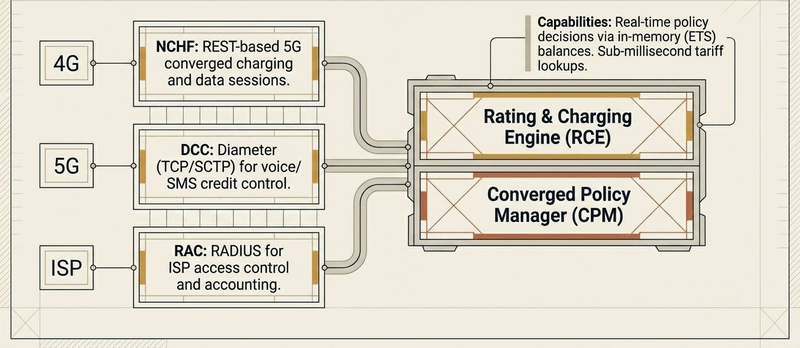
Usage charged in real time against live balances, with policy control that can enforce speed tiers and fair-use as it happens. This is nomia's core: NCHF for the 5G core, real-time rating against in-memory balances.
QoS and fair-use enforcement
The policy layer that throttles, shapes, or prompts an upsell when a customer crosses a fair-use threshold. Enforced in real time by the converged policy manager, not discovered in a monthly report.
Billing and balance
Converged billing across FWA and any existing fixed-line or mobile products, one customer record, one bill. Prepaid, postpaid, or hybrid on the same engine.
Support and assurance
First-line support for a product where 'my internet is slow' could be coverage, CPE, policy, or network. The operating model has to define who owns which diagnosis.
Migration path for adjacent fixed-line services
If you’re a fibre operator, the path to eventually bringing fixed-line onto the same platform, so you’re not running FWA and fibre on separate stacks forever.
The sequence
From spectrum to a billable business, in phases.
The journey pairs platform capability with consulting support at each phase. The network build runs in parallel; this is the commercial and operational track.
Phase 1
Shape the business case
The commercial model for the FWA business: addressable homes, pricing against fibre and mobile alternatives, CPE economics, fair-use thresholds that protect the margin. The strategy and business case engagement does this work.
Strategy and business casePhase 2
Design the operating model
Who owns the coverage-check process, the CPE supply chain, the QoS policy, the support diagnosis tree. FWA fails operationally more often than technically; the operating model engagement defines the wiring.
Operating model designPhase 3
Stand up the commercial platform
fullCIRCLE NEXT carries the catalogue, charging, policy, billing, and customer record. nomia handles real-time charging and policy against the 5G core. For a fibre operator, this runs alongside the existing fixed-line stack rather than replacing it on day one.
5G charging and policyPhase 4
Launch and enforce
The product goes live. Real-time charging and fair-use enforcement run from the first customer, not bolted on after the margin problem appears. Soft-launch to a controlled cohort, then open up.
Phase 5
Converge over time
Bring adjacent fixed-line and mobile products onto the same platform on your schedule, so the FWA launch becomes the start of a converged commercial operation rather than another silo.
DeploymentA concrete near-term shape
What the first 90 days can look like.
The exact shape depends on whether you’re greenfield or adding FWA to an existing operation. A common first-90-days shape:
- Weeks 1 to 3Business case and pricing locked. Fair-use thresholds modelled against cell economics.
- Weeks 4 to 8Operating model designed. Platform configuration begun: catalogue, charging rules, policy tiers.
- Weeks 9 to 12Soft launch to a controlled cohort in one coverage area. Real-time charging and fair-use enforcement live. Performance baselined before opening to the broader market.
The commitment is to prove the commercial model on real customers in one area before scaling, not to launch everywhere at once and discover the fair-use problem at scale.
Platform, consulting, experience
The journey in one view.
Platform: 5G charging and policy
nomia carries the real-time charging and policy core for FWA.
See 5G chargingConsulting: strategy to launch
Strategy, operating model, and BSS architecture engagements shape and sequence the launch.
Explore consultingExperience: production 5G charging
Real-time 5G charging running on own-network operators today.
Read the experienceTell us where your FWA business is today.
Spectrum allocated and a plan to build? A fibre base you want to extend with wireless? A launch date that’s getting close and a commercial stack that isn’t ready? Each is a familiar starting point.